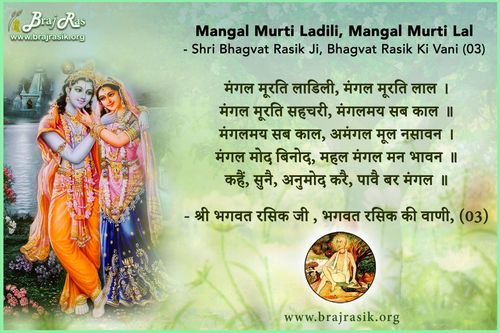
Mangal Moorti Laadili, Mangal Moorti Laal. [1]
Mangal Moorti Sahachari, Mangalmay Sab Kaal. [2]
Mangalmay Sab Kaal, Amangal Mool Nasaavan. [3]
Mangal Mod Binod, Mahal Mangal Man Bhaavan.
Kahain, Sunai, Anumod Karai, Paavai Bar Mangal.
- Shri Bhagwat Rasik, Bhagwat Rasik Ki Vani, Ananyarasikabharan Granth (1.3)
In this verse, Shri Bhagwat Rasik conveys that within his devotion to the divine play, everything is imbued with the essence of auspiciousness. He elucidates that within the Nikunj palace, Shri Radha represents the very embodiment of auspiciousness, while Shri Krishn embodies this auspiciousness as well. [1]
The "Sehchari" (Shri Radha's companions) also embody auspiciousness, and every moment spent in this realm is inherently auspicious. [2]
This continuous stream of auspiciousness leaves no room for any inauspiciousness; it eradicates all inauspiciousness at its root. [3]
Moreover, the delightful and humorous exchanges within this setting are also considered auspicious. The divine Nikunj Mahal, the palace of Shri Radha, serves as a physical representation of this auspiciousness. [4]
The Rasiks, those who relish and appreciate this divine play, themselves embody auspiciousness. Every facet of the "Nitya Vihar" (eternal pastimes) is inherently auspicious. Those who engage in and devote themselves to the practice of "Nitya Vihar Upasna" (blissful devotion) are blessed with the ultimate nectar of auspicious and blissful fulfillment. [5]
Mangal Moorti Sahachari, Mangalmay Sab Kaal. [2]
Mangalmay Sab Kaal, Amangal Mool Nasaavan. [3]
Mangal Mod Binod, Mahal Mangal Man Bhaavan.
Kahain, Sunai, Anumod Karai, Paavai Bar Mangal.
- Shri Bhagwat Rasik, Bhagwat Rasik Ki Vani, Ananyarasikabharan Granth (1.3)
In this verse, Shri Bhagwat Rasik conveys that within his devotion to the divine play, everything is imbued with the essence of auspiciousness. He elucidates that within the Nikunj palace, Shri Radha represents the very embodiment of auspiciousness, while Shri Krishn embodies this auspiciousness as well. [1]
The "Sehchari" (Shri Radha's companions) also embody auspiciousness, and every moment spent in this realm is inherently auspicious. [2]
This continuous stream of auspiciousness leaves no room for any inauspiciousness; it eradicates all inauspiciousness at its root. [3]
Moreover, the delightful and humorous exchanges within this setting are also considered auspicious. The divine Nikunj Mahal, the palace of Shri Radha, serves as a physical representation of this auspiciousness. [4]
The Rasiks, those who relish and appreciate this divine play, themselves embody auspiciousness. Every facet of the "Nitya Vihar" (eternal pastimes) is inherently auspicious. Those who engage in and devote themselves to the practice of "Nitya Vihar Upasna" (blissful devotion) are blessed with the ultimate nectar of auspicious and blissful fulfillment. [5]