(Sawaiya)
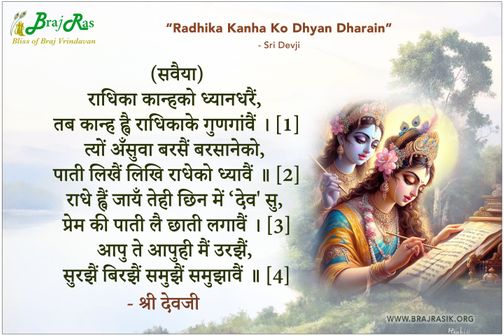
Radhika Kanh Kau Dhyan Dhare, Tab Kanh Hvai Radhika Ke Gun Gave. [1]
Tyon Asuba Barse Barsane Ko, Paati Likhe Likhe Gun Gaave. [2]
Radhe Hvai Jai Ghareek Mein Dev Su, Prem Ki Paati Le Chhati Lagave. [3]
Aapne Aaphi Mein Urjhe Surjhe Urjhe Samujhe Samujhave. [4]
- Shri Devji
[This is an example of Śrī Rādhā Rānī’s mahābhāva state]
First, Śrī Rādhikā contemplates upon Śrī Kṛṣṇa in deep meditation and, in that very moment, imagining herself as Śrī Kṛṣṇa, begins to praise Śrī Rādhā (herself). [1]
Then, immersed in Kṛṣṇa-bhāva, she recollects Barsāṇā's pastimes, tears begin to flow from her eyes, and, imagining herself as Śrī Kṛṣṇa, she writes a love-letter to Śrī Rādhā (i.e., to herself). [2]
In the very next moment, receiving this letter, she thinks that Śrī Kṛṣṇa has written it to her, and upon seeing it, she embraces it with all her heart. [3]
In this way, Śrī Rādhā remains entwined in her own līlā—she understands herself and simultaneously instructs herself. [4]
Radhika Kanh Kau Dhyan Dhare, Tab Kanh Hvai Radhika Ke Gun Gave. [1]
Tyon Asuba Barse Barsane Ko, Paati Likhe Likhe Gun Gaave. [2]
Radhe Hvai Jai Ghareek Mein Dev Su, Prem Ki Paati Le Chhati Lagave. [3]
Aapne Aaphi Mein Urjhe Surjhe Urjhe Samujhe Samujhave. [4]
- Shri Devji
[This is an example of Śrī Rādhā Rānī’s mahābhāva state]
First, Śrī Rādhikā contemplates upon Śrī Kṛṣṇa in deep meditation and, in that very moment, imagining herself as Śrī Kṛṣṇa, begins to praise Śrī Rādhā (herself). [1]
Then, immersed in Kṛṣṇa-bhāva, she recollects Barsāṇā's pastimes, tears begin to flow from her eyes, and, imagining herself as Śrī Kṛṣṇa, she writes a love-letter to Śrī Rādhā (i.e., to herself). [2]
In the very next moment, receiving this letter, she thinks that Śrī Kṛṣṇa has written it to her, and upon seeing it, she embraces it with all her heart. [3]
In this way, Śrī Rādhā remains entwined in her own līlā—she understands herself and simultaneously instructs herself. [4]