
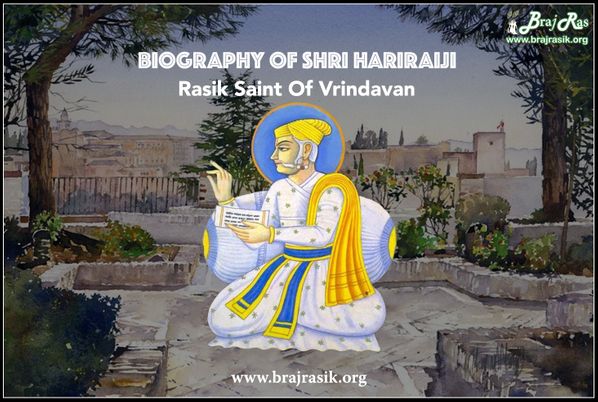
Appearance :
Shri Hariraiji was the great-grandson of Shri Gusain Shri Vitthalnath Ji and the son of Shri Kalyanraiji. Shri Kalyanraiji was the son of Shri Govindalalji (the Second Son of Shri Gusainji). Shri Hariraiji appeared on the 5th day of the dark fortnight in the month of Ashwin (Sept-Oct) in the year 1591 in Gokul, Braj.
Education & Spiritual Initiation:
Shri Hariraiji's sacred thread ceremony took place at Gokul at the age of 8 years. At that time, Shri Gusainji's eldest son Shri Giridharji was present. As Shri Giridharji was the eldest in the family, so he was supposed to initiate Shri Hariraiji by giving the Brahmasambandha Mantra. But Shri Giridharji told Shri Gokulnathji (Fourth Son of Shri Gusain Ji) to give the Brahmasambandha to Shri Hariraiji. In this way, Shri Gokulnathji was the Diksha Guru of Shri Hariraiji. Shri Hariraiji acquired knowledge from Shri Gokulnathji too. His lifestyle was extraordinarily different. He used to avail every moment of his life in the best way and preferred himself to be called ‘Haridas’ (Servant of Shri Krishn). He always gave supremacy to sentiment of surrender for Shri Krishn. In spite of being born in the lineage of Acharya (preceptor), he had extreme respect for the Vaishnavas.
An episode of Shri Harirai Ji who knew the future incidents :
Shri Harirayji’s younger brother Shri Gopeshwaraji was very devoted to the worship of Shri Krishn. His wife too was very cooperative in the worship. Shri Hariraiji by his divine power knew that Shri Gopeshwarji’s wife was unlikely to live longer. Also, he was well aware of the grief his brother was about to face. He started writing letters to enable him to come out of worldly grief. As Shri Gopeshwarji always kept himself busy serving God, he hardly got time to go through the letters. But when the tragedy took place, he read the letters on appeal of some followers, and that drastically helped him to come out of worldly grief. Very soon he got back to his former divine activities.
Marriage:
Shri Hariraiji was married at the age of 24 years. His wife was "Pujya Shri Sundarvanta Bahuji". Shri Hariraiji had 4 sons named Shri Govindji, Shri Vitthalraiji, Shri Chotaji, and Shri Goraji. Shri Hariraiji's younger brother was Shri Gopeshwarji, for whom Shri Hariraji composed the well-known Granth Shikshaptra. For which, He is known as "ShikshaSagar" Shri Hariraiji.
Baithaks:
Shri Hariraiji mostly stayed at Gokul, Govardhan, etc. Sometimes, he use to visit other regions as well. Shri Hariraiji, during his visit to other regions, use to disseminate and give discourses on Mahaprabhu Shri Vallabhacharyaji's Principles. Side by side, he also did a lot of work to find out the life incidents of Shri Vallabhacharyaji, Shri Gusainji, and their Vaishnava disciples too. During his visit to other regions, he use to deliver discourses, at that place, which are known as Hariraiji's Baithak. These Baithaks are mostly located in Vraj, Rajasthan, and Gujarat. From these Baithaks, the following are the main:
1. Gokul
2. Savli (Gujarat)
3. Dakor (Gujarat)
4. Jambu
5. Jaisalmer
6. Nathdwara
7. Khimnor
Relocating from Braj:
Due to the atrocities and acts of Aurangzeb against the Hindu religion, in 1670, all the Goswami Acharyas had to quit Braj (as it was the throbbing zone of Hindi Religion) and settled down to Hindu kingdoms with their worshipful deities and Literature. Due to the orders of Aurangzeb, the Hindu temples like Shri KeshavDev Mandir in Mathura were being destroyed. Other big temples in Vrindavan, Gokul, and Govardhan were also destroyed. During this time only, the main deity of Pushtimarg, Shri Shrinathji's Swaroop (deity) was also relocated secretly to Nathdwara in Rajasthan. In the night of the 15th day of the bright fortnight in the month of Ashwin (Sept-Oct), Shrinathji was taken from Shri Govardhan. With that Swaroop, the Goswami Acharyas also accompanied with their Granthas (literature), etc. They went to several places in Hindu kingdoms to settle and finally, they reached Nathdwara. After developing the Magnificent temple there, Shrinathji was enthroned on the 7th day of the dark fortnight in the month of Falgun (March-April). In this way, it took 2 years 4 months, and 7 days to relocate Shrinathji from Govardhan to Nathdwara. During this historical event, wherever Shrinathji was made halted and offered service, these places were known as "Charan Chowkis". The detailed description of those places and entire travel is narrated by Shri Hariraiji in 'Shri Govardhannathji's Prakatya Vaarta'. Due to this, the unpopular village of Mevad i.e. Sinhad (Nathdwara) became the center of Pushtimarg.
Apart from Shrinathji, other deities like Shri Hariraiji's worshipful deity Shri Vitthalnathji (Nidhi Swaroop of Pushtimarg), Shri Dwarkadhishji (Nidhi Swaroop of Pushtimarg), and Shri Navnitpriyaji (Nidhi Swaroop of Pushtimarg) were also relocated to Mevad.
Compositions :
Shri Hariraiji was especially well known for his literary works. At that time, he was one of the scholars of Pushtimarg. Shri Dwarkadas Parikh has enlisted Shri Hariraiji's about 166 Sanskrit creations. He used the chhap [impression] of "Rasik" in His padas.
Apart from the above Sanskrit works, there are several other small compositions written in several languages by him and some are enlisted below:
Shri Mahaprabhuji's Prakatya Vaarta, Shri Govardhannathji Prakatya Vaarta, Nij Vaarta, Nij Vaarta (Second), Mahaprabhuji and Gusaiji Swaroop Vichar, Shrinathji Charan Chinh, Shri Gokulnathji's Baithak Charitra, Sharan Mantra and Vyakhya, Marg Shiksha, Nav Grah Aachar, Vaishnav Nitya Krutya, Trutiya Gruh Utsav Malika, Aparadh Varnan, Raas Prasang, Ban Yatra, Samarpan Gadhyarth, Samarpan Gadhyarth Second, Jap Prakaar, Bhagwat Swaroop Nirnaya, Das Marma Bhasa, Marg Swaroop Siddhant, Pushti Dradhav, Dwidalakmak Swaroop Vichar, Sfut Vachanamrit, 84 Vaishnava Vaarta Bhavnavali, Mahaprabhuji's Prakatya Vaarta Bhavnavali, Nij Vaarta Bhavnavali, Gharu Vaarta Bhavnavali, Seven Swaroop Bhavna, Seven Swaroop Bhavna (Second), Charan Chinh Bhavna, Swamini Charan Chinh Bhavna, Seven Balak Swaroop Bhavna, Nitya Leela Bhavna, Dwadash Nikunj Bhavna, Van Yatra Bhavna, Nav Grah Bhavna, Shrinathdwara Bhavna, Seva Bhavna, Utsav Bhavna, Basant Hori Bhavna, Utsav Bhavna, Chappanbhog Bhavna, Chaak Biri Bhavna, Bhavna Tray.
Disciples :
There were many disciples, servants, and devotees of Shri Hariraiji. From these, Shri Vitthalnath Bhatt, Harjeevandas, Premji, and Shobha Maji were very famous. Vitthalnath Bhatt composed a very important and well-known Granth "Sampraday Kalpadruma" by hearing the discourses of Shri Hariraiji. This Granth is composed in the Braj language and it was composed for the king of Kishangadh Raja Mansingh.
Disappearance :
Shri Hariraiji was 80 years old when he came to Mevad. He passed his rest 45 years at Mevad. At this time and place only, he composed most of the literature. He disappeared at the age of 125 in 1716 at Khimnor.