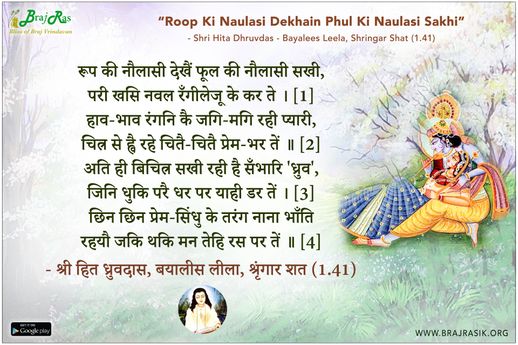
Roop Ki Naulasi Dekhain Phul Ki Naulasi Sakhi,
Pari Khasi Naval Rangileju Ke Kar Tein. [1]
Hav-Bhav Rangani Kai Jagi-Magi Rahi Pyari,
Chitr Se Hvai Rahe Chitai-Chitai Prem-Bhar Tein. [2]
Ati Hi Bichitr Sakhi Rahi Hai Sambhari Dhruv,
Jini Dhuki Parai Dhar Par Yahi Dar Tein. [3]
Chhin Chhin Prem-Sindhu Ke Tarang Nana Bhanti
Rahayau Jaki Thaki Man Tehi Ras Par Tein.[4]
- Shri Hita Dhruvdas - Bayalees Leela, Shringar Shat (1.41)
Śrī Rādhā, whose limbs are as tender as petals, slipped from the loose hands of Śrī Kṛṣṇa, just as a flower branch slowly slides from someone’s hand. [1]
Pari Khasi Naval Rangileju Ke Kar Tein. [1]
Hav-Bhav Rangani Kai Jagi-Magi Rahi Pyari,
Chitr Se Hvai Rahe Chitai-Chitai Prem-Bhar Tein. [2]
Ati Hi Bichitr Sakhi Rahi Hai Sambhari Dhruv,
Jini Dhuki Parai Dhar Par Yahi Dar Tein. [3]
Chhin Chhin Prem-Sindhu Ke Tarang Nana Bhanti
Rahayau Jaki Thaki Man Tehi Ras Par Tein.[4]
- Shri Hita Dhruvdas - Bayalees Leela, Shringar Shat (1.41)
Śrī Rādhā, whose limbs are as tender as petals, slipped from the loose hands of Śrī Kṛṣṇa, just as a flower branch slowly slides from someone’s hand. [1]
The sakhīs observed that Prīyā is radiant with the hues of most enchanting gestures, and the beloved (Priyatama) gazes continuously at Her, absorbed in the flow of love, still like a painting. [2]
Śrī Dhruvadās Jī says that the exceptionally extraordinary and loving sakhīs carefully support the couple, concerned that the lovers, immersed in the intoxication of love, might fall unconscious to the ground. [3]
Thus, in the ocean of the couple’s love, fresh waves of emotion continually rise. Witnessing this exquisite play of love-rasa, even the minds of their attendants (parikara) are immersed in bliss. [4]