
Birth:
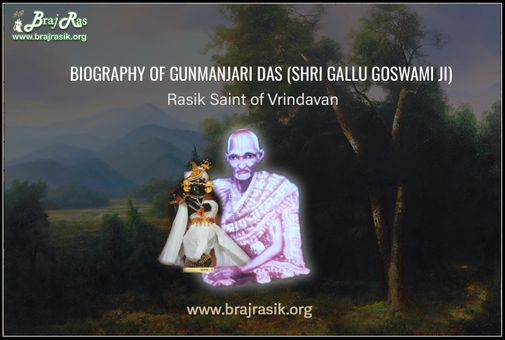
Gaudiya Vaishnava Acharya Shri Gallu Goswami Ji's father was Shri Raman Dayal Ji and His mother was Shri Suryadevi Goswami. Shri Gallu Ji's birthdate was on the 8th day of the dark fortnight in the month of Jyesht in 1827. His only son, Shri Radhacharan Goswami, was born to him.
Childhood:
Shri Ramandayal Goswami primarily resided in Farrukhabad, where Shri Gallu Ji pursued his studies. Even from a young age, Shri Gallu Ji exhibited saintly qualities, earning him the esteemed title of "Mahatma," which everyone affectionately addressed him. He led a humble life, sustaining himself on a simple diet of just a single piece of bread and some greens to nourish his body.
His life revolved around two core principles: self-contemplation and the worship of Shri Radharaman Ji. These pursuits consumed his existence, and he remained deeply engrossed in them.
However, Gallu Ji's path of devotion faced formidable challenges. His father's financial troubles, particularly debts incurred in Vrindavan, forced their family to relocate to Farrukhabad. This separation from Vrindavan, was a significant hardship for Gallu Ji, undermining his devotion.
Nonetheless, he resolved to overcome this adversity. Given his youth, securing employment or establishing a business to repay his father's debts was not an option. His only recourse was to engage in Sankirtan (singing of devotional songs) and discourse on the glories of Lord Hari. His debut discourse took place at the age of 10, hosted by Shah Biharilal in Lucknow. Remarkably, he received a generous donation of Rs. 500, a substantial sum for the times, which contributed to the repayment of a portion of the debt.
Emerging as a true devotee and an accomplished narrator at a very young age, Gallu ji made a special place in the hearts of the devotees. Yet, envy brewed within his own family, leading to a poisoning attempt on him when he was just 16 years old. Thankfully, swift intervention saved his life. Despite this, Gallu Ji displayed remarkable forgiveness, preventing any legal action against the person responsible. Instead, he continued to treat his assailant with kindness throughout his life.
Marriage:
In 1844, when Shri Gallu Ji was just 17 years old, his father, Shri Ramandayal Ji, arranged his marriage. Tragically, shortly after the wedding, his wife passed away.
When his father proposed a second marriage, suggesting a girl from Farrukhabad, Gallu Ji expressed his reluctance. He conveyed, "If you genuinely seek my well-being, please do not burden me with the responsibilities of a household once more. However, if you insist, why not wear gold instead of iron? Rather than a girl from Farrukhabad, why not marry me to a girl from Vrindavan, so that we may at least have the opportunity to visit this sacred place?"
Understanding the wisdom in his son's words, Shri Ramandayal Ji accepted Gallu Ji's proposal and arranged his marriage to Shri Suryadevi, the daughter of Shri Jagannath Mishra, in Vrindavan.
Arrival in Vrindavan:
Gradually, Gallu Ji managed to clear all his father's debts through the donations he received while narrating the divine stories of Lord Hari. With the financial burdens lifted, the path to Vrindavan became accessible for both father and son. They embarked on their journey to Vrindavan and settled there.
However, during their journey to Vrindavan, their vehicle was intercepted by robbers. These thieves seized a box belonging to Gallu Ji, which contained valuable books. Gallu Ji, displaying remarkable composure, addressed them saying, "Brothers, this box only contains books, of no value to you. Please leave it and take whatever else you desire." Surprisingly, the robbers heeded his words, leaving the box of books behind while taking away all other possessions.
Love for the language of Braj:
Till the last moment, Gallu Ji embraced the Braj language as his own. It flowed effortlessly from his lips, and throughout his entire life, he never uttered a word in any other tongue.
In the context of the Braj language, a memoir of Shri Gallu Ji's life gained widespread fame. Shri Kundan Lal Shah (also known as Shri Lalit Kishori) and Shri Phundan Lal Shah (Shri Lalit Madhuri) of Lucknow held Shri Gallu Ji in the highest regard, considering him like a God. They often remarked, "After encountering Shri Gallu Ji, one's heart naturally turns to the deity Shri Radharamanlal, bestowing profound inner peace." (This quote is taken from the diary of Shri Radhacharan Goswami).
An interesting incident occurred when Shri Gallu Ji granted permission for a gunshot to occur on Shah Ji's premises. Shah Ji, a resident of Lucknow, personally visited Shri Gallu Ji along with a group of people to obtain this authorization. Many were curious, given Shri Gallu Ji's exclusive use of the Braj language, how he would convey permission for the gunshot. In response to Shah Ji's inquiry, Shri Gallu Ji spontaneously expressed in the Braj language, "When the iron tube, filled with black powder, is ignited, a booming sound emerges." This explanation delighted all present, and they humbly prostrated themselves at the feet of Gallu Ji. The beauty and resonance of the words in the Braj language within this sentence were truly captivating.
Routine and Living:
Shri Gallu Ji dedicated his entire life to serving the people of Braj, serving the poor, and tending to the welfare of cows. He harbored no inclination for accumulating material possessions; instead, he readily shared all he had with fellow devotees. Due to his generous nature, He was unable to understand worldly matters and dealings.
Engaged in uninterrupted service, devotional songs, and the worship of Shri Radharaman Dev, Shri Gallu Ji remained absorbed in these activities around the clock. During his time, devotees and saints firmly believed that Gallu Ji enjoyed direct darshan (divine vision) and conversations with Shri Radharaman Lal, due to his profound spiritual connection.
Renunciation:
The narration of Shrimad Bhagwat was not limited to specific cities but extended to places like Kashi, Shahjahanpur, and Bharatpur as well. When Shri Gallu Ji conducted these narrations in the government temples of Bharatpur, a remarkable spectacle unfolded. People would place him in a grand procession, passing through the bustling market. The air would resonate with reverent cheers and salutations from both sides, making it challenging for the procession to advance.
All the financial gifts he received from these narrations were entirely dedicated to the welfare of others. He never used these funds for personal or familial purposes; instead, they were directed towards the support of Saints, Vaishnavas, and the local residents of Braj. Gallu Ji held a deep affection for the people of Braj, with a special focus on those from Nandgaon and Barsana. His home accommodated between ten to fifteen guests from Braj at any given time.
In a notable testament to his selflessness, Shri Radhacharan Goswami Ji recorded that he earned a substantial sum, at least one lakh rupees, which was wholeheartedly spent in divine service and charitable endeavors. His personal expenses were exceptionally modest. His guiding principle was that the funds derived from Bhagwat narrations should be utilized exclusively for the service of the Lord and His devotees. He believed in using only what was necessary for basic sustenance.
Conferred the title "Gunmanjari" by Shri Radharaman Ji:
Shri Gallu Ji Maharaj, known in the realm of poetry as Gunmanjari, carries a name traditionally associated with Shri Gopal Bhatt Goswami Ji. The intriguing aspect to ponder, as per scriptural accounts, is how Shri Gallu Ji came to be known as Gun Manjari.
Among his notable compositions are Guru Paramparashtak Mala, Shri Gopal Bhatt Shatak, and Shri Bhagwat Padavali. It was while crafting the ‘Radharaman Padavali’, a work detailing the annual festivals and daily rituals, that Shri Radharaman lal graced him with a divine revelation. In a dream, Shri Radharaman Dev pronounced, "You are Gunmanjari" (excerpted from Shri Radhacharan Ji's diary).
As a result, every concluding line of Shri Gallu Ji's verses now carries the name Gunmanjari. He remained in a perpetual state of spiritual immersion, often shedding tears as he composed verses dedicated to his beloved deity, Shri Radharaman Dev. His profound devotion elevated him to the esteemed position of the foremost divine saint within the Gaudiya sect.
Deep Affection for the Mangala Aarti of Shri Radharaman Ji:
Shri Gallu Ji always used to perform Mangala Aarti. When it was the turn of another Goswami, he used to reach the doors of that Goswami and request him to allow me to perform Mangala Aarti. Most of the Goswamis cooperated with him, but there were some such arrogant Goswamis who declined his request and scolded him, some gentleman even raised his hand on him. When he did not go for Mangala Aarti, he used to do Sohni (broom) service outside the temple. People used to ask him, Why you did not go to the temple today, then He would tearfully confess, "I must have committed some transgression, therefore, Radharaman lal has not called me today". The descendants of the Goswami who slapped him no longer exist at present. Sri Galluji’s unwavering sense of service and humility serves as an enduring example for all.
Deep Affection for Shri Radharaman Ji's Prasad:
After the Rajbhog service of Shri Radharaman Dev, Gallu Ji adhered to his daily ritual to beg alms for a Prasadi roti (bread) of Radharaman Ji from Goswamis. However, on one occasion, an irritable Goswami scolded him, exclaiming, "You come here every day to ask for bread. Don't you have any shame? You won't receive any bread today."
Gallu Ji, ever humble and understanding, did not retort or harbor any ill feelings. In his perspective, the Goswami had done no wrong. The decision to grant or withhold bread rested solely with Radharaman Ji's divine will. Servants held no authority to distribute even a morsel of His prasad against His wishes. Thus, when he failed to receive the bread, he solely held Shri Radharaman Dev accountable, conveying to Him, "I am Your devoted servant, and I am here to make a request. You are the bestower, and whether to grant it or not is entirely at Your discretion."
It's noteworthy that Shri Radharaman Ji, too, would not hesitate to address any mistakes in Gallu Ji's service. He would convey His feedback through dreams, ensuring that the service remained impeccable.
Once Radharaman instructed that there is no water for Him:
Once, a Goswami inadvertently made an oversight. He forgot to replenish the water in Lord Radharaman's pot. It was around one o'clock in the middle of the night when Shri Gallu Ji urgently exclaimed, "Open the sanctum door! My Radharaman is thirsty!" His outcry disrupted the peaceful night, provoking the displeasure of the other Goswamis.
However, Gallu Ji remained steadfast in his plea, his persistence unwavering. Ultimately, at 1:30 AM, the temple doors were opened in the presence of the other Goswamis. As Shri Gallu Ji and the Goswami went inside together, they saw that the pot was empty, there was no water. Tears flowed up in the eyes of everyone present, moved by this touching moment.
Context of Snake:
Once, during temple service, a Goswami encountered an unexpected obstacle. When he tried to open the temple door, he discovered a black snake blocking the entrance. Despite their best efforts, the snake refused to leave, creating a significant problem for them.
Fortunately, Shri Gallu Ji, who had just finished bathing, arrived on the scene. Remarkably, as soon as he appeared, the snake departed, allowing the temple service to proceed smoothly and peacefully.
Visit to Varanasi and Instructions of Sri Radharaman Lal:
Shri Gallu Ji visited Varanasi only once in his lifetime, upon receiving numerous invitations. Here, he was accorded a grand and divine reception. The scholars of Varanasi, however, began to challenge him and assert their intellectual prowess. Gallu Ji, though deeply devoted, was not a scholar in the conventional sense.
Feeling disheartened by the situation, he received guidance and solace in a dream from his beloved deity, Shri Radharaman Dev. His Lord advised him to respond to just one question. The following morning, surrounded by the scholars, Shri Gallu Ji humbly stated, "Please ask only one question."
The scholars collectively inquired, "What is the duty of a householder?" To this, Shri Gallu Ji replied, "The sole duty of a householder is to worship Lord Hari and seek His divine presence."
With these words, he prostrated himself at the scholars' feet, tears of devotion filling his eyes. His profound humility and selflessness left everyone present utterly astounded. The learned assembly unanimously praised Shri Gallu Ji, describing him as a divine soul, an embodiment of simplicity, and an epitome of sacrifice. They paid him deep respects with hundreds of obeisances.
Opinion of the great saints of Braj:
A Bengali devotee named Krishna used to live near Siddha Shri Jai Krishnadas Baba (of Kamyavan). He constantly sought guidance on the path to salvation. One day, as he was humbly serving Baba's feet, Baba unexpectedly shared, "Krishna, there is presently a great saint named Shri Gallu Ji Goswami at the Radharaman temple. If you truly seek your well-being and redemption, go seek the company of this saint. By serving him, you will receive the Lord's blessings."
Following Shri Jai Krishnadas Baba's directive, Krishna surrendered himself at the feet of Shri Gallu Ji. He dedicated his life to serving Shri Gallu Ji until the saint's final moments. Strikingly, witnesses reported seeing Krishna by Shri Gallu Ji's side even during the last rites, but after that, he seemingly disappeared. It is believed that on the third day following Shri Gallu Ji's passing, Krishna also departed from this world on the banks of the sacred Yamuna river. Observers noted the serene expression on Krishna's lifeless face, suggesting that the gates to the abode of Vaikunth, the spiritual realm, had opened for him.
Upon hearing this incident, Shri Jai Krishnadas Baba's eyes welled up with tears. He remarked to those present, "Saints and the Lord are exceedingly compassionate."
Shri Lalit Kishori Ji's love for Shri Gallu Goswami Ji:
Shri Lalit Kishori Ji in one of his verses in 'Abhilash Madhuri' has expressed his desire to attain the loving state of mind of Shri Gallu Ji -
Kabahunk Aisi Banani Banaigi.
Goswami Shrigalluji-Si Meri, Mati Rati Roop Sanaigi.
Upon arriving in Vrindavan, Shri Gallu Ji continued to embark on journeys outside the sacred town for Srimadbhagwat discourses, a practice that persisted for several days. His frequent destination was Lucknow, where he would visit Shah Kundanlal (Shri Lalit Kishori Ji) and Shah Phundanlal (Shri Lalit-Madhuri Ji), both of whom held Shri Gallu Ji in high spiritual regard.
Shri Gallu Ji not only recounted the divine narratives of Lord Hari to them but also provided guidance on worship. The profound joy and enthusiasm that surged within them whenever Shri Gallu Ji visited is aptly captured in a composition by Lalit Kishori Ji, with its opening lines as follows:
Goswami Aaj Yahan Galluji Aaye Hain,
Vaahva Hai, Aji Vaahva Hai.
Swamini Kripase Bhaye Mere Man Bhaaye Hain,
Vaahva Hai, Aji Vaahva Hai.
Oh, what a delight! Shri Gallu Goswami Ji has graced us with his presence, a blessing bestowed upon us by Shri Radha herself, filling my heart with immense joy.
Shri Gallu Ji's Devotion and Contribution at Shri Radharaman Temple:
Shri Gallu Ji Maharaj personally led all the hymns and songs within the premises of Shri Radharaman temple. He sang birthday greetings to Shri Radharaman Ji, Holi songs, and more with great love His deepest desire was to dedicate every moment of his life in the service of Sri Radharaman.
Furthermore, Shri Gallu Ji meticulously compiled a comprehensive guide detailing the daily and yearly rituals for serving Shri Radharaman Ji. This manual still resides within the temple's sanctum, inscribed in beautiful script within a register. Presently, all the Goswamis continue to use this manual, referring to it during various festivals and ceremonies when needed.
Mysterious Predictions of Shri Gallu Ji:
During Shri Gallu Ji's visit to Varanasi, he received a warm welcome and rode on an elephant. He conducted Bhagwat discourses, and silver coins were gifted as a token of appreciation. Before returning to Vrindavan, he called the Shah family along with the Madhauji family, and the Visuji family he entrusted a pitcher filled with silver coins to local families in Varanasi, insisting that the money should be used for Vrindavan in the future.
After Shri Gallu Ji's passing, when two of Shri Radhacharan Goswami's sons died, a grandson named Shri Adwait Charan Goswami remained. Shri Radhacharan Goswami had arranged for the family's expenses and Lord Shadbhuj Mahaprabhu Ji's upkeep to be funded from the Varanasi deposits until the child grew up.
Shri Gallu Ji's foresight about the money's purpose in Vrindavan was realized, fulfilling his prediction. This insight was confirmed by Shri Goswami Radha Charan Ji. Shri Gallu Ji was a revered ascetic, divine saint, and devoted worshiper of Shri Radha Charan Dev.
Establishment of Lord Shadbhuj Mahaprabhu:
Saint Gallu Ji dedicated his life to the service of Mahaprabhu, the residents of Braj, Vaishnavas, and the impoverished. He remained completely absorbed in these three aspects of service. His devotion led to the establishment of temples in various places, including Bharatpur, Shahjahanpur, Badayun, Farrukhabad, Jabvat, and more. Additionally, in 1875, he installed Lord Shadbhuj Mahaprabhu in his own residence.
This ancient deity had its origins in Dhaka and was previously cared for by a Bengali woman living in a modest hut. She was not only a disciple but also a fervent devotee of Shri Gallu Ji. She entrusted this Deity to Shri Gallu Ji before departing from this world. Since then, the beautiful Deity of Shadbhuj Mahaprabhu has been continuously worshiped, now by the sixth generation of devotees who serve Shadbhuj Mahaprabhu with unwavering devotion.
Composition:
Shri Gallu Goswami Ji has composed many verses of Shri Radharaman Ji's Ashtayam Sewa (eight times service), Janmotsav (birth celebrations), and Badhayi (greetings), Sanjhi (flower rangoli), Hindol (swing), Phool Bangla, (flower palace), etc. which are compiled in the texts called "Shri Radharaman Padmanjari" and "Shri Yugal Chhadm". In the last line of each of his verses, there is an impression of "Gunmanjari". Even today the verses of 'Shri Radharaman-Padmanjari' are sung in the temple of Shri Radharaman on different occasions.
Some verses composed by Shri Gallu Goswami Ji:
Shri Radha Raman's Divine Form:
Shriradharaman Sir Mukut Sohe.
Mor Chandrikan Ko Chit Chore Jo Johai So Mohe.
Priya Or Jhuk Rahyau Pranay Bas Barani Sakai So Ko Hai.
Gun Manjari Chhata Nirakhat Hi Rati Pati Garv Khasau Hai.
A beautiful crown adorns the head of Shri Radharaman ji, which steals the heart of Mor Chandrika. The crown of Shri Krishna is inclined towards Shri Radha, seeing whose glimpse, Kaamdev's pride is shattered.
Mere Parat Hiye Mein Leeken.
Shriradharaman Laalji Ki Sakhi Roop Madhuri Peeken.
Ang-Ang Chhavi Kahi Na Jayi Shrivrishabhanu Lali Ke.
Chhaki Rahon Nis Vaasar Ho Sang Gun Manjari Ali Ke.
In my heart, a glimpse of the beautiful form of Shri Radharaman Lal Ji and Shri Radha has manifested, I say this with a vow. The beauty of every limb of Shri Radha is undescribable, with whom Gun Manjari Sakhi remains engrossed in divine love day and night.
Shri Radharaman Salaune Shyam.
Naval Kishor Madhuri Murati, Ang Ang Abhiram.
Shri Vrishabhan Kishori Gori Shobhit Sundar Vam.
Vrindavipin Vilasi Ras Nidhi ‘Gunamanjari’ Sukhadham.
Shri Radharaman is the most lovely Thakura, whose form of sweetness is always new, who remains ever-young, and whose every limb is tossed by the pleasant divine love-bliss. Shri Radhika, the charming daughter of King Vrishbhanu, always remains seated on the left side of Him. Shri Gunmanjari Das ji says, “Shri Radharaman Lal, who is the treasure-house of nectar and the abode of all the pleasures, always dwells in Shri Vrindavan Dham”.
Shriradharaman Lal Kachhu Dije,
Apani Pranpriya Parikar Ki Dasiganana Kijai.
Aur Kachhu Nahin Chahon Chit Mein Yeh Binti Suni Lije,
Shrigunmanjari Ke Taate Hriday Prem Mein Bhijai.
O Shri Radharaman Lal, If you wish to give me something, then please make me the maidservant of the intimate devotees of your soul beloved Shri Radha. I don’t desire anything else, so please listen to my prayer. May my heart remain drenched in your love by the grace of Shri Radha’s devotees, says Shri Gunmanjari Ji.
Sri Radha’s name: The Verse of Greatness:
Hamare Dhan Shyamaju Kau Naam.
Jakaun Ratat Nirantar Mohan, Nandnandan Ghanshyam.
Pratidin Nav-Nav Mahamadhuri, Barsati Aaathon Jaam.
Gunmanjari Navkunj Milave, Shri Vrindavan Dham.
Our one and only treasure of life is the name of Shri Shyama Ju [Sri Radha] which is the treasure of Shri Krishn as well who Himself recites it unceasingly. Shri Gunamanjari says, “It is because of the impact and grace of the name of Shri Radha that One may reside in ever-new Nikunjas of Vrindavan, where every day, unparalleled and ever-new beauty always showers”.
Disappearance:
Shri Gallu Ji's unwavering devotion led him to perform daily Aartis for Shri Radharaman and Mahaprabhu. His love for them grew so profound that he vowed never to leave Vrindavan in 1880.
He dedicated himself entirely to Sri Radharaman’s service, entrusting household matters to Shri Radhacharan Goswami. On the first day of the dark fortnight in the month of Margshirsh in 1890, Shri Gallu Ji peacefully departed, entering eternal service in the divine Nikunj Palace.
Remarkably, even after his cremation, his Kanthi (tulsi bead necklace) remained intact, with people treasuring its grains as sacred Prasad.
Gaudiya Vaishnava Acharya Shri Gallu Goswami Ji's father was Shri Raman Dayal Ji and His mother was Shri Suryadevi Goswami. Shri Gallu Ji's birthdate was on the 8th day of the dark fortnight in the month of Jyesht in 1827. His only son, Shri Radhacharan Goswami, was born to him.
Childhood:
Shri Ramandayal Goswami primarily resided in Farrukhabad, where Shri Gallu Ji pursued his studies. Even from a young age, Shri Gallu Ji exhibited saintly qualities, earning him the esteemed title of "Mahatma," which everyone affectionately addressed him. He led a humble life, sustaining himself on a simple diet of just a single piece of bread and some greens to nourish his body.
His life revolved around two core principles: self-contemplation and the worship of Shri Radharaman Ji. These pursuits consumed his existence, and he remained deeply engrossed in them.
However, Gallu Ji's path of devotion faced formidable challenges. His father's financial troubles, particularly debts incurred in Vrindavan, forced their family to relocate to Farrukhabad. This separation from Vrindavan, was a significant hardship for Gallu Ji, undermining his devotion.
Nonetheless, he resolved to overcome this adversity. Given his youth, securing employment or establishing a business to repay his father's debts was not an option. His only recourse was to engage in Sankirtan (singing of devotional songs) and discourse on the glories of Lord Hari. His debut discourse took place at the age of 10, hosted by Shah Biharilal in Lucknow. Remarkably, he received a generous donation of Rs. 500, a substantial sum for the times, which contributed to the repayment of a portion of the debt.
Emerging as a true devotee and an accomplished narrator at a very young age, Gallu ji made a special place in the hearts of the devotees. Yet, envy brewed within his own family, leading to a poisoning attempt on him when he was just 16 years old. Thankfully, swift intervention saved his life. Despite this, Gallu Ji displayed remarkable forgiveness, preventing any legal action against the person responsible. Instead, he continued to treat his assailant with kindness throughout his life.
Marriage:
In 1844, when Shri Gallu Ji was just 17 years old, his father, Shri Ramandayal Ji, arranged his marriage. Tragically, shortly after the wedding, his wife passed away.
When his father proposed a second marriage, suggesting a girl from Farrukhabad, Gallu Ji expressed his reluctance. He conveyed, "If you genuinely seek my well-being, please do not burden me with the responsibilities of a household once more. However, if you insist, why not wear gold instead of iron? Rather than a girl from Farrukhabad, why not marry me to a girl from Vrindavan, so that we may at least have the opportunity to visit this sacred place?"
Understanding the wisdom in his son's words, Shri Ramandayal Ji accepted Gallu Ji's proposal and arranged his marriage to Shri Suryadevi, the daughter of Shri Jagannath Mishra, in Vrindavan.
Arrival in Vrindavan:
Gradually, Gallu Ji managed to clear all his father's debts through the donations he received while narrating the divine stories of Lord Hari. With the financial burdens lifted, the path to Vrindavan became accessible for both father and son. They embarked on their journey to Vrindavan and settled there.
However, during their journey to Vrindavan, their vehicle was intercepted by robbers. These thieves seized a box belonging to Gallu Ji, which contained valuable books. Gallu Ji, displaying remarkable composure, addressed them saying, "Brothers, this box only contains books, of no value to you. Please leave it and take whatever else you desire." Surprisingly, the robbers heeded his words, leaving the box of books behind while taking away all other possessions.
Love for the language of Braj:
Till the last moment, Gallu Ji embraced the Braj language as his own. It flowed effortlessly from his lips, and throughout his entire life, he never uttered a word in any other tongue.
In the context of the Braj language, a memoir of Shri Gallu Ji's life gained widespread fame. Shri Kundan Lal Shah (also known as Shri Lalit Kishori) and Shri Phundan Lal Shah (Shri Lalit Madhuri) of Lucknow held Shri Gallu Ji in the highest regard, considering him like a God. They often remarked, "After encountering Shri Gallu Ji, one's heart naturally turns to the deity Shri Radharamanlal, bestowing profound inner peace." (This quote is taken from the diary of Shri Radhacharan Goswami).
An interesting incident occurred when Shri Gallu Ji granted permission for a gunshot to occur on Shah Ji's premises. Shah Ji, a resident of Lucknow, personally visited Shri Gallu Ji along with a group of people to obtain this authorization. Many were curious, given Shri Gallu Ji's exclusive use of the Braj language, how he would convey permission for the gunshot. In response to Shah Ji's inquiry, Shri Gallu Ji spontaneously expressed in the Braj language, "When the iron tube, filled with black powder, is ignited, a booming sound emerges." This explanation delighted all present, and they humbly prostrated themselves at the feet of Gallu Ji. The beauty and resonance of the words in the Braj language within this sentence were truly captivating.
Routine and Living:
Shri Gallu Ji dedicated his entire life to serving the people of Braj, serving the poor, and tending to the welfare of cows. He harbored no inclination for accumulating material possessions; instead, he readily shared all he had with fellow devotees. Due to his generous nature, He was unable to understand worldly matters and dealings.
Engaged in uninterrupted service, devotional songs, and the worship of Shri Radharaman Dev, Shri Gallu Ji remained absorbed in these activities around the clock. During his time, devotees and saints firmly believed that Gallu Ji enjoyed direct darshan (divine vision) and conversations with Shri Radharaman Lal, due to his profound spiritual connection.
Renunciation:
The narration of Shrimad Bhagwat was not limited to specific cities but extended to places like Kashi, Shahjahanpur, and Bharatpur as well. When Shri Gallu Ji conducted these narrations in the government temples of Bharatpur, a remarkable spectacle unfolded. People would place him in a grand procession, passing through the bustling market. The air would resonate with reverent cheers and salutations from both sides, making it challenging for the procession to advance.
All the financial gifts he received from these narrations were entirely dedicated to the welfare of others. He never used these funds for personal or familial purposes; instead, they were directed towards the support of Saints, Vaishnavas, and the local residents of Braj. Gallu Ji held a deep affection for the people of Braj, with a special focus on those from Nandgaon and Barsana. His home accommodated between ten to fifteen guests from Braj at any given time.
In a notable testament to his selflessness, Shri Radhacharan Goswami Ji recorded that he earned a substantial sum, at least one lakh rupees, which was wholeheartedly spent in divine service and charitable endeavors. His personal expenses were exceptionally modest. His guiding principle was that the funds derived from Bhagwat narrations should be utilized exclusively for the service of the Lord and His devotees. He believed in using only what was necessary for basic sustenance.
Conferred the title "Gunmanjari" by Shri Radharaman Ji:
Shri Gallu Ji Maharaj, known in the realm of poetry as Gunmanjari, carries a name traditionally associated with Shri Gopal Bhatt Goswami Ji. The intriguing aspect to ponder, as per scriptural accounts, is how Shri Gallu Ji came to be known as Gun Manjari.
Among his notable compositions are Guru Paramparashtak Mala, Shri Gopal Bhatt Shatak, and Shri Bhagwat Padavali. It was while crafting the ‘Radharaman Padavali’, a work detailing the annual festivals and daily rituals, that Shri Radharaman lal graced him with a divine revelation. In a dream, Shri Radharaman Dev pronounced, "You are Gunmanjari" (excerpted from Shri Radhacharan Ji's diary).
As a result, every concluding line of Shri Gallu Ji's verses now carries the name Gunmanjari. He remained in a perpetual state of spiritual immersion, often shedding tears as he composed verses dedicated to his beloved deity, Shri Radharaman Dev. His profound devotion elevated him to the esteemed position of the foremost divine saint within the Gaudiya sect.
Deep Affection for the Mangala Aarti of Shri Radharaman Ji:
Shri Gallu Ji always used to perform Mangala Aarti. When it was the turn of another Goswami, he used to reach the doors of that Goswami and request him to allow me to perform Mangala Aarti. Most of the Goswamis cooperated with him, but there were some such arrogant Goswamis who declined his request and scolded him, some gentleman even raised his hand on him. When he did not go for Mangala Aarti, he used to do Sohni (broom) service outside the temple. People used to ask him, Why you did not go to the temple today, then He would tearfully confess, "I must have committed some transgression, therefore, Radharaman lal has not called me today". The descendants of the Goswami who slapped him no longer exist at present. Sri Galluji’s unwavering sense of service and humility serves as an enduring example for all.
Deep Affection for Shri Radharaman Ji's Prasad:
After the Rajbhog service of Shri Radharaman Dev, Gallu Ji adhered to his daily ritual to beg alms for a Prasadi roti (bread) of Radharaman Ji from Goswamis. However, on one occasion, an irritable Goswami scolded him, exclaiming, "You come here every day to ask for bread. Don't you have any shame? You won't receive any bread today."
Gallu Ji, ever humble and understanding, did not retort or harbor any ill feelings. In his perspective, the Goswami had done no wrong. The decision to grant or withhold bread rested solely with Radharaman Ji's divine will. Servants held no authority to distribute even a morsel of His prasad against His wishes. Thus, when he failed to receive the bread, he solely held Shri Radharaman Dev accountable, conveying to Him, "I am Your devoted servant, and I am here to make a request. You are the bestower, and whether to grant it or not is entirely at Your discretion."
It's noteworthy that Shri Radharaman Ji, too, would not hesitate to address any mistakes in Gallu Ji's service. He would convey His feedback through dreams, ensuring that the service remained impeccable.
Once Radharaman instructed that there is no water for Him:
Once, a Goswami inadvertently made an oversight. He forgot to replenish the water in Lord Radharaman's pot. It was around one o'clock in the middle of the night when Shri Gallu Ji urgently exclaimed, "Open the sanctum door! My Radharaman is thirsty!" His outcry disrupted the peaceful night, provoking the displeasure of the other Goswamis.
However, Gallu Ji remained steadfast in his plea, his persistence unwavering. Ultimately, at 1:30 AM, the temple doors were opened in the presence of the other Goswamis. As Shri Gallu Ji and the Goswami went inside together, they saw that the pot was empty, there was no water. Tears flowed up in the eyes of everyone present, moved by this touching moment.
Context of Snake:
Once, during temple service, a Goswami encountered an unexpected obstacle. When he tried to open the temple door, he discovered a black snake blocking the entrance. Despite their best efforts, the snake refused to leave, creating a significant problem for them.
Fortunately, Shri Gallu Ji, who had just finished bathing, arrived on the scene. Remarkably, as soon as he appeared, the snake departed, allowing the temple service to proceed smoothly and peacefully.
Visit to Varanasi and Instructions of Sri Radharaman Lal:
Shri Gallu Ji visited Varanasi only once in his lifetime, upon receiving numerous invitations. Here, he was accorded a grand and divine reception. The scholars of Varanasi, however, began to challenge him and assert their intellectual prowess. Gallu Ji, though deeply devoted, was not a scholar in the conventional sense.
Feeling disheartened by the situation, he received guidance and solace in a dream from his beloved deity, Shri Radharaman Dev. His Lord advised him to respond to just one question. The following morning, surrounded by the scholars, Shri Gallu Ji humbly stated, "Please ask only one question."
The scholars collectively inquired, "What is the duty of a householder?" To this, Shri Gallu Ji replied, "The sole duty of a householder is to worship Lord Hari and seek His divine presence."
With these words, he prostrated himself at the scholars' feet, tears of devotion filling his eyes. His profound humility and selflessness left everyone present utterly astounded. The learned assembly unanimously praised Shri Gallu Ji, describing him as a divine soul, an embodiment of simplicity, and an epitome of sacrifice. They paid him deep respects with hundreds of obeisances.
Opinion of the great saints of Braj:
A Bengali devotee named Krishna used to live near Siddha Shri Jai Krishnadas Baba (of Kamyavan). He constantly sought guidance on the path to salvation. One day, as he was humbly serving Baba's feet, Baba unexpectedly shared, "Krishna, there is presently a great saint named Shri Gallu Ji Goswami at the Radharaman temple. If you truly seek your well-being and redemption, go seek the company of this saint. By serving him, you will receive the Lord's blessings."
Following Shri Jai Krishnadas Baba's directive, Krishna surrendered himself at the feet of Shri Gallu Ji. He dedicated his life to serving Shri Gallu Ji until the saint's final moments. Strikingly, witnesses reported seeing Krishna by Shri Gallu Ji's side even during the last rites, but after that, he seemingly disappeared. It is believed that on the third day following Shri Gallu Ji's passing, Krishna also departed from this world on the banks of the sacred Yamuna river. Observers noted the serene expression on Krishna's lifeless face, suggesting that the gates to the abode of Vaikunth, the spiritual realm, had opened for him.
Upon hearing this incident, Shri Jai Krishnadas Baba's eyes welled up with tears. He remarked to those present, "Saints and the Lord are exceedingly compassionate."
Shri Lalit Kishori Ji's love for Shri Gallu Goswami Ji:
Shri Lalit Kishori Ji in one of his verses in 'Abhilash Madhuri' has expressed his desire to attain the loving state of mind of Shri Gallu Ji -
Kabahunk Aisi Banani Banaigi.
Goswami Shrigalluji-Si Meri, Mati Rati Roop Sanaigi.
Upon arriving in Vrindavan, Shri Gallu Ji continued to embark on journeys outside the sacred town for Srimadbhagwat discourses, a practice that persisted for several days. His frequent destination was Lucknow, where he would visit Shah Kundanlal (Shri Lalit Kishori Ji) and Shah Phundanlal (Shri Lalit-Madhuri Ji), both of whom held Shri Gallu Ji in high spiritual regard.
Shri Gallu Ji not only recounted the divine narratives of Lord Hari to them but also provided guidance on worship. The profound joy and enthusiasm that surged within them whenever Shri Gallu Ji visited is aptly captured in a composition by Lalit Kishori Ji, with its opening lines as follows:
Goswami Aaj Yahan Galluji Aaye Hain,
Vaahva Hai, Aji Vaahva Hai.
Swamini Kripase Bhaye Mere Man Bhaaye Hain,
Vaahva Hai, Aji Vaahva Hai.
Oh, what a delight! Shri Gallu Goswami Ji has graced us with his presence, a blessing bestowed upon us by Shri Radha herself, filling my heart with immense joy.
Shri Gallu Ji's Devotion and Contribution at Shri Radharaman Temple:
Shri Gallu Ji Maharaj personally led all the hymns and songs within the premises of Shri Radharaman temple. He sang birthday greetings to Shri Radharaman Ji, Holi songs, and more with great love His deepest desire was to dedicate every moment of his life in the service of Sri Radharaman.
Furthermore, Shri Gallu Ji meticulously compiled a comprehensive guide detailing the daily and yearly rituals for serving Shri Radharaman Ji. This manual still resides within the temple's sanctum, inscribed in beautiful script within a register. Presently, all the Goswamis continue to use this manual, referring to it during various festivals and ceremonies when needed.
Mysterious Predictions of Shri Gallu Ji:
During Shri Gallu Ji's visit to Varanasi, he received a warm welcome and rode on an elephant. He conducted Bhagwat discourses, and silver coins were gifted as a token of appreciation. Before returning to Vrindavan, he called the Shah family along with the Madhauji family, and the Visuji family he entrusted a pitcher filled with silver coins to local families in Varanasi, insisting that the money should be used for Vrindavan in the future.
After Shri Gallu Ji's passing, when two of Shri Radhacharan Goswami's sons died, a grandson named Shri Adwait Charan Goswami remained. Shri Radhacharan Goswami had arranged for the family's expenses and Lord Shadbhuj Mahaprabhu Ji's upkeep to be funded from the Varanasi deposits until the child grew up.
Shri Gallu Ji's foresight about the money's purpose in Vrindavan was realized, fulfilling his prediction. This insight was confirmed by Shri Goswami Radha Charan Ji. Shri Gallu Ji was a revered ascetic, divine saint, and devoted worshiper of Shri Radha Charan Dev.
Establishment of Lord Shadbhuj Mahaprabhu:
Saint Gallu Ji dedicated his life to the service of Mahaprabhu, the residents of Braj, Vaishnavas, and the impoverished. He remained completely absorbed in these three aspects of service. His devotion led to the establishment of temples in various places, including Bharatpur, Shahjahanpur, Badayun, Farrukhabad, Jabvat, and more. Additionally, in 1875, he installed Lord Shadbhuj Mahaprabhu in his own residence.
This ancient deity had its origins in Dhaka and was previously cared for by a Bengali woman living in a modest hut. She was not only a disciple but also a fervent devotee of Shri Gallu Ji. She entrusted this Deity to Shri Gallu Ji before departing from this world. Since then, the beautiful Deity of Shadbhuj Mahaprabhu has been continuously worshiped, now by the sixth generation of devotees who serve Shadbhuj Mahaprabhu with unwavering devotion.
Composition:
Shri Gallu Goswami Ji has composed many verses of Shri Radharaman Ji's Ashtayam Sewa (eight times service), Janmotsav (birth celebrations), and Badhayi (greetings), Sanjhi (flower rangoli), Hindol (swing), Phool Bangla, (flower palace), etc. which are compiled in the texts called "Shri Radharaman Padmanjari" and "Shri Yugal Chhadm". In the last line of each of his verses, there is an impression of "Gunmanjari". Even today the verses of 'Shri Radharaman-Padmanjari' are sung in the temple of Shri Radharaman on different occasions.
Some verses composed by Shri Gallu Goswami Ji:
Shri Radha Raman's Divine Form:
Shriradharaman Sir Mukut Sohe.
Mor Chandrikan Ko Chit Chore Jo Johai So Mohe.
Priya Or Jhuk Rahyau Pranay Bas Barani Sakai So Ko Hai.
Gun Manjari Chhata Nirakhat Hi Rati Pati Garv Khasau Hai.
A beautiful crown adorns the head of Shri Radharaman ji, which steals the heart of Mor Chandrika. The crown of Shri Krishna is inclined towards Shri Radha, seeing whose glimpse, Kaamdev's pride is shattered.
Mere Parat Hiye Mein Leeken.
Shriradharaman Laalji Ki Sakhi Roop Madhuri Peeken.
Ang-Ang Chhavi Kahi Na Jayi Shrivrishabhanu Lali Ke.
Chhaki Rahon Nis Vaasar Ho Sang Gun Manjari Ali Ke.
In my heart, a glimpse of the beautiful form of Shri Radharaman Lal Ji and Shri Radha has manifested, I say this with a vow. The beauty of every limb of Shri Radha is undescribable, with whom Gun Manjari Sakhi remains engrossed in divine love day and night.
Shri Radharaman Salaune Shyam.
Naval Kishor Madhuri Murati, Ang Ang Abhiram.
Shri Vrishabhan Kishori Gori Shobhit Sundar Vam.
Vrindavipin Vilasi Ras Nidhi ‘Gunamanjari’ Sukhadham.
Shri Radharaman is the most lovely Thakura, whose form of sweetness is always new, who remains ever-young, and whose every limb is tossed by the pleasant divine love-bliss. Shri Radhika, the charming daughter of King Vrishbhanu, always remains seated on the left side of Him. Shri Gunmanjari Das ji says, “Shri Radharaman Lal, who is the treasure-house of nectar and the abode of all the pleasures, always dwells in Shri Vrindavan Dham”.
Shriradharaman Lal Kachhu Dije,
Apani Pranpriya Parikar Ki Dasiganana Kijai.
Aur Kachhu Nahin Chahon Chit Mein Yeh Binti Suni Lije,
Shrigunmanjari Ke Taate Hriday Prem Mein Bhijai.
O Shri Radharaman Lal, If you wish to give me something, then please make me the maidservant of the intimate devotees of your soul beloved Shri Radha. I don’t desire anything else, so please listen to my prayer. May my heart remain drenched in your love by the grace of Shri Radha’s devotees, says Shri Gunmanjari Ji.
Sri Radha’s name: The Verse of Greatness:
Hamare Dhan Shyamaju Kau Naam.
Jakaun Ratat Nirantar Mohan, Nandnandan Ghanshyam.
Pratidin Nav-Nav Mahamadhuri, Barsati Aaathon Jaam.
Gunmanjari Navkunj Milave, Shri Vrindavan Dham.
Our one and only treasure of life is the name of Shri Shyama Ju [Sri Radha] which is the treasure of Shri Krishn as well who Himself recites it unceasingly. Shri Gunamanjari says, “It is because of the impact and grace of the name of Shri Radha that One may reside in ever-new Nikunjas of Vrindavan, where every day, unparalleled and ever-new beauty always showers”.
Disappearance:
Shri Gallu Ji's unwavering devotion led him to perform daily Aartis for Shri Radharaman and Mahaprabhu. His love for them grew so profound that he vowed never to leave Vrindavan in 1880.
He dedicated himself entirely to Sri Radharaman’s service, entrusting household matters to Shri Radhacharan Goswami. On the first day of the dark fortnight in the month of Margshirsh in 1890, Shri Gallu Ji peacefully departed, entering eternal service in the divine Nikunj Palace.
Remarkably, even after his cremation, his Kanthi (tulsi bead necklace) remained intact, with people treasuring its grains as sacred Prasad.