
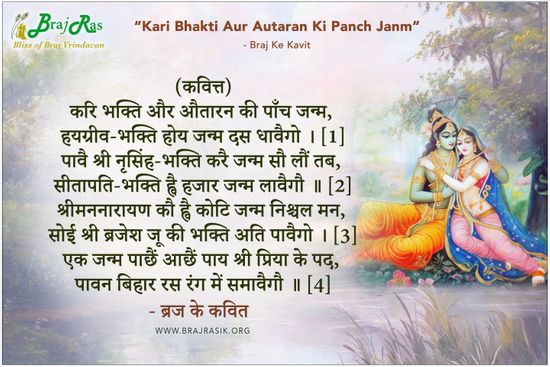
(Kavitt)
Kari Bhakti Aur Autaran Ki Pancha Janam,
Hayagriv-Bhakti Hoy Janm Das Dhavaigo.
Pavai Shri Nrsinh-Bhakti Karai Janm Sau Laun Tab,
Sitapati-Bhakti Hvai Hajar Janm Lavaigau.
Shrimannarayan Kau Hvai Koti Janm Nishchal Mann,
Soi Shri Brajesh Ju Ki Bhakti Ati Pavaigo.
Ek Janm Pachen Achhen Pay Shri Priya Ke Pad,
Puran Bihar Ras Rang Mein Samavaigau.
- Braj Ke Kavitt
(This Kavitta is written by a Rasika saint of Vṛndāvan, which is the poetic translation of the words of Lord Śiva to Pārvatī Mātā in Hari Līlāmṛta Tantra.)
Through devotion to other incarnations over five lifetimes, devotion arises for the ‘Hayagrīva’ (the horse‑necked avatar of Lord Viṣṇu). Through devotion to Hayagrīva for ten lifetimes, the devotion to the Nṛsiṁha Avatar of Lord Viṣṇu arises. Through devotion to Nṛsiṁha for a hundred lifetimes, devotion to Lord Rāma arises. Through devotion to Lord Rāma for a thousand years, the devotion to Śriman Nārāyaṇa arises. Through devotion to Śrī Nārāyaṇa for millions of years with a pure heart, devotion to Lord Kṛṣṇa, the Lord of Braj, arises. Through devotion to Lord Kṛṣṇa, the devotion to Śrī Rādhā’s lotus feet arises. Through devotion to Śrī Rādhā’s lotus feet, one is blessed with the supremely divine nectar of Nitya Vihāra rasa of Vṛndāvan, in a single birth.
Lord Śiva says to Mother Pārvatī in Śrī Harilīlāmṛta Tantra as such (the meaning of which is written above).
anyesāmavatārāṇāṁ sevāyaḥ pañca janmaṣu.
karoti tasya turagagrīve devīratirbhavet.
tatrāpitannmanāṁ devī naracadaśajanmaṣu.
prahalāda rakṣaka tasya śrī nṛsiṁhe ratirbhavet.
tatrāpiyaditaścitto narascecchatajanmaṣu.
raghunātha padāṁbhoje bhakti prāpnoti śāśvartī.
tasya sītāpateḥ yayastu sahaśrāṁ teṣu janmaṣu.
etadeva phala tasya nārāyaṇa parāyaṇaḥ.
tatrāpi niścala mataḥ naraḥ koṭyaṁta janmaṣu.
śrī vṛndāvana madhyasthe śrīkṛṣṇa bhakti mān bhavet.
tat priyā-carṇāṁbhoje bhāva gadgad cetasā.
tannāma paramo bhakti prāpnuyādekajanmanā.
pūrṇastasmān mahābhāge śrīmān vṛndāvaneśvaraḥ.
bihārossyatayānityamittyāhurbe dvādin.