
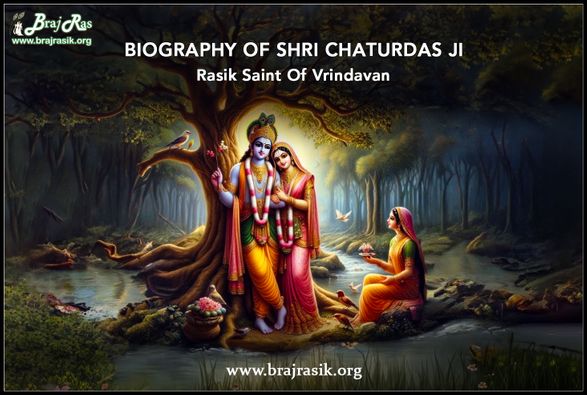
Birth:
Swami Chaturdas Ji was born on the sixth day of a bright fortnight in the month of Bhadra (Sept) in 1753 in a Chaturvedi family of Mathura in the Etawah district of Uttar Pradesh.
Childhood:
Being close to Braj, Swami Chaturdas Ji's parents often used to visit Braj-Vrindavan. Since the Mathur Chaturvedi Brahmins were inclined towards Tatiya Sthan since the time of Swami Lalit Kishori Dev Ji, hence they also got associated with it traditionally and developed faith in the culture here. The atmosphere of the house also became pleasant which had an impact on child Chaturdas too. He also came to Vrindavan many times with his parents, saw glimpses of Shri Banke Bihari Ji, saw the mode of life of the saints of Tatiya Sansthan, visited other famous temples, shrines, forests, and ashrams, participated in festivals, etc. Enjoyed hearing the recitation and singing of Vanis and returned with his parents, But these travels had such an impact on his heart that as he grew young he left home and started living in Vrindavan.
Spiritual Life:
During that period, Swami Lalitmohini Dev Ji was seated on the throne of Tatiya Sthan. His pervasive influence and divine presence were evident in the surroundings, establishing an atmosphere of renunciation and love. Revered as the foremost among the perfected saints, he garnered the utmost respect. Numerous tales of selflessness and compassionate acts had become renowned among the people. At that time, this place emerged as the center for saintly services. These circumstances profoundly impacted the young Chaturdas, who, already had faith in the teachings of Swami Shri Haridas Ji Maharaj, chose to become a disciple of Swami Lalitmohini Dev Ji and began residing in the same sacred place.
Deep Love for Shri Bhagwat Rasik Ji:
Residing in Tatiya Sthan, Shri Chaturdas Ji encountered Shri Bhagwat Rasik Ji, the foremost disciple of Swami Shri Lalit Mohini Dev Ji. Shri Bhagwat Rasik Ji had become a topic of widespread discussion among the people, admired for his exceptional devotion, exemplary way of living, purity, and profound renunciation. Swami Chaturdas Ji was deeply influenced by these qualities. With the blessing of his spiritual master, he sought permission to live with Shri Bhagwat Rasik Ji at a stepwell, which, now in a dilapidated state, is known as 'Bhagwat Rasik Ji ki Bavdi (stepwell) or Radha Bavadi' in Vrindavan. This sacred site remains under the guardianship of Tatiya Sansthan. Shri Chaturdev's worshipful deity Sri Chatur Bihariji is also seated at Radha Bavadi.
Seated on the Throne at Tatiya Sthan:
Both Swami Chaturdas Ji and Shri Bhagwat Rasik Ji were devoted disciples of Swami Lalitmohini Dev Ji, and both exemplified profound devotion and remarkable renunciation, but Swami Chaturdas Ji shared a closer bond with the spiritual master compared to Shri Bhagwat Rasik Ji.
It is recounted that at a later time, Swami Lalitmohini Dev Ji, angered by some mistake of Shri Bhagwat Rasik Ji, went to the extent of instructing him to leave Vrindavan. While Shri Bhagwat Rasik Ji obediently followed this directive, his response was not favorable. In his writings, he even expressed dissatisfaction, stating that...
"Chela Kaahu Ke Nahin, Guru Kaahu Ke Naahin', 'Taate Ham Parihare Dehmaani Guru-Chela' and 'Hum Shisha Shyama Shyam Ke, Guru Hum Shyama Shyam'.
- Shri Bhagwat Rasik Ji, Ananya Nishchayatmak Granth, Uttarardh (40, 41)
"Neither am I anyone's disciple nor anyone's Spiritual Master. Not only are disciples of Shyama Shyam but also their guru. "
The result was that the then saints and devotees of Tatiya Sansthan also completely ignored Shri Bhagwat Rasik Ji and no one even mentioned his name anywhere.
Swami Chaturdas Ji's position in this regard was different from that of his Godbrother (Shri Bhagwat Rasik Ji). He continued to be the spiritual master's most loved, best and trusted disciple, and as per his wish, after his disappearance, he also sat on the throne of Tatiya Sansthan in 1801.
Considerations Opposing Throne Acquisition:
In 'Lalit Prakash' written by Swami Sahchari Sharan Ji, a very detailed and miraculous biography of nine Acharyas of Sri Haridasi sect up to Swami Lalitmohini Dev Ji has been given, but the biography of Swami Shri Chaturdas Ji was mere one-liner, who was the favorite disciple of Swami Lalitmohini Dev Ji and who ascended the throne immediately after him. Only this much has been mentioned -
Shrimat Chaturdas Sukh Saja. Guru Gaddi Par Aay Viraja.
- Swami Sahcharisharan Ji, Lalit Prakash, Uttararddh, Chaubola (494)
“Shri Chaturdas Ji, the source of joy for all, assumed the position of the spiritual master's throne.”
At the time when Swami Chaturdas Ji ascended the throne, the assembly included saints with three distinct mindsets. First, there were those unwaveringly dedicated to the path of Nitya Vihar, as revealed by Swami Shri Haridas Ji Maharaj, committed to moving forward without conflict or fear, with closed eyes to distractions. The second group comprised individuals internally devoted to Swami Haridas Ji's customs, yet circumstances compelled them to synchronize with others. The third category consisted of those indifferent to the path of Nitya Vihar, solely seeking external splendor and grandeur.
Among these groups, the first category exhibited no attraction to the Acharya's throne. Their absorption in the supreme bliss of Nitya Vihar prevented them from even glancing towards the ensuing struggle for the throne.
The individuals belonging to the second category, despite lacking an inherent attachment to the throne, aspired to occupy it. Their motive was to prevent any unwanted elements from contaminating the pure nectar refined by Swami Lalit Kishori Dev Ji.
In contrast, those in the third category had no intention of assuming the throne. They acknowledged their inability to adhere to the system advocated by Swami Shri Haridas Ji Maharaj. Nevertheless, their efforts were fervently directed towards ensuring that whoever occupied the throne became a figurative puppet, dancing according to their whims. In essence, only someone from the second category was deemed fit for the throne. The most outstanding candidate in this category was Swami Chaturdasji, who, without contemplating external considerations and unaffected by outsider opinions, boldly took his place on the spiritual master's throne as the exclusive guardian of Nityavihar Rasa.
Disagreement Amid Outwardly Directed Saints and relinquishing the throne of Tatiya Sthan:
After ascending the throne, Swami Shri Chaturdas Ji considered his spiritual master Swami Shri Lalitmohini Dev Ji as his spiritual role model. He dedicated himself to serving the saints impartially, showing respect to adherents of all sects and maintaining connections with devotee-loving householders. Even wealthy moneylenders and kings took pride and felt blessed by generously supporting Swami Chaturdas Ji financially, but his inner self remained unwaveringly connected to the profoundly enduring realm of pure Nityavihar worship as revealed by Shri Swami Haridas Ji. Despite engaging in worldly activities, he steadfastly established the principle that -
Shri Swami Haridas Bhaj, Chhaandi Sakal Janjar.
Ya Chakkar Mein Mati Parai, Yah Jhoothau Sansar.
- Swami Chaturdasji Ki Saakhi (10)
"Leave all the entanglements and worship Swami Haridas ji, do not get trapped in this material world, it is false."
Without getting into the trap of logic and reasoning, he simply said -
Chaturdas Haridas Kau Adbhut Nityavihar.
Yahan Auran Ki Kaha Chalai, Ved Na Paavai Paar.
- Swami Chaturdasji Ki Saakhi (12)
“The Nitya Vihar, the eternal love-play of Shri Radha Krishna, as revealed by Swami Shri Haridas Ji, is truly astounding. Even the Vedas, with their vast knowledge, fall short in fully grasping its essence, what to say of others.”
Some extroverted saints raised an unnecessary concern, asserting that Chaturdasji's association with Bhagwat Rasik Ji persisted even after Swami Lalitmohini Dev Ji expressed displeasure, implicating him as disobedient to his spiritual master. According to them, one who disobeys the master forfeits the right to remain on the throne.
This matter was sensationalized by the extroverts, entangling a majority of the people in its web. Even the ashram's staff, including the storekeeper, priest, and cook, fell prey to this dilemma. Though they refrained from openly expressing their sentiments, their behavior underwent noticeable changes.
Swami Chaturdas Ji, perceptive to the unfolding situation, took the initiative to clarify that he occupied the throne solely at the command of his spiritual master and harbored no personal inclination towards it. He emphasized his commitment to preserving the integrity of Swami Haridas Ji's Nitya Vihar Rasa, in accordance with the instructions he had received. He made it clear that he would continue this duty as long as his master desired, but the moment he received the order, he would promptly vacate the throne, understanding the nature of Swamiji's path—an aspect incomprehensible to any sect or opinion. This nectar-like essence is the eternal source residing in the hearts of the beloved couple, Shri Shyama Shyam, unquenchable even by the thirst of millions of deserts.
However, outsiders misconstrued his words, giving rise to new interpretations. Communal leaders were provoked, and dissenting voices grew louder and more widespread, attracting additional supporters. The overall environment turned toxic.
At that time there was no influential saint in the place who could calm this civil strife. Shri Bhagavatrasik ji had already left Vrindavan. Other Rasiks who understood Swami Haridas Ji's mode of worship did not even want to look at this plight. The remaining persons had reached the camp of the opponents willingly or unknowingly. In such a situation, for how long would a highly detached Acharya like Swami Chaturdasji, who was engaged in the worship of Nitya Vihar Rasa, continue to bear this burden on his head? Understanding the wish of Shri Hari and his spiritual master, he left Tatiya Sthan in 1802 and moved towards the east towards the banks of Shri Yamuna Ji. There was a high mound, surrounded by picturesque forests. Seeing this secluded place suitable for meditating, he started living there and continued singing the wonderful pastimes of Shri Radha Krishna there till his last days.
Swami Shri Chaturdas Ji's Samadhi remained visible on that mound for a long time, but some time ago Shri Yamuna Ji took him inside her water.
Three verses of greetings related to Swami Shri Chaturdasji have also been found under the Chaap (impression) of Swami Shri Radhacharandas Ji Maharaj, the current Acharya sitting on the throne of Tatiya Sansthan of Haridasi sect -
Pragati Swamini Chatur Saheli.
Shrivrindavan Nityabiharau, Kunj Kunj Drumbeli.
Sakhi Sahchari Sukh Barsavat, Priya Syam Karat Hain Keli.
Shri Radhacharan Nirakhi Bali Jaavain, Kahi Kahi Prem Saheli.
“In Shri Vrindavan, the manifestation of Chatur Saheli (Chaturdas Ji) brings joy as Sakhis shower happiness and divine pastimes unfold with Shri Shyamashyam. Witnessing this enchanting spectacle, Shri Radha Charan sacrifices himself.”
Baajat Badhayi Angan Maahin.
Prakate Chaturdas Sukhdayi, Anand Ur Na Samaahin.
Shriharidas Kripa Ke Sagar Vipul Vinod Badhaahin.
Shri Radhacharan Tori Trin Chhavi Par, Mand-Mand Musikyaahin.
"The songs of greetings are being played in Shri Vrindavan as Shri Chaturdas Ji has appeared, everyone is filled with joy."
Bhaadon Sukal Chhathu Sukhdayi.
Chaturdas Ras Raasi Prakat Bhaye Sobha Sahaj Suhayi.
Mor-Chakor Sor, Pik Gaavain, Kunjani Bajat Badhayi.
Shriradhacharan Dekhi Ke Harashain, Rank Mahanidhi Payi.
“The sixth day of the bright fortnight of Bhado (Sept) is very pleasant, as the ocean of nectar, Shri Chaturdas Ji has appeared.”
Disciple Tradition:
Among the disciples of the renounced order of Shri Swami Chaturdasji, the names of the following seven disciples are notable -
1. Shri Vrindavan Das ji, 2. Shri Girdhari Das ji, 3. Shri Govind Das ji, 4. Shri Dayal Das ji, 5. Shri Vipul Das ji, 6. Shri Ladili Das ji and 7. Bhimasakhi ji.
Among these, the tradition of Bhimasakhi Ji is present, which is as follows - Shri Bhimasakhiji - Shri Charandasji - Shri Girivardasji - Shri Krishnadasji - Shri Chanchaldasji - Shri Kanhardasji - Shri Radhikadasji.
Composition:
The quantity of Shri Chaturdas Ji's compositions remains unspecified in any available records. Presently, through the collaboration of Shri Baba Albelidas Ji and the esteemed priest Shri Deenbandhudas Ji, only 13 couplets and 4 verses related to the nectar have been discovered.
Despite the limited volume of Shri Swami Chaturdas Ji's writings, his content reflects an unwavering devotion to Swami Shri Haridas Ji Maharaj. Similar to his predecessors, he holds the belief that the attainment of Nityavihar Rasa is possible solely through the grace of Shri Swami Haridas Ji, considering it the ultimate purpose of life. The bliss derived from Nitya Vihar is deemed the highest form of happiness. The exclusive source of this nectar of Nitya Vihar is Shri Vrindavan and one's residence in Shri Vrindavan is contingent upon the grace of the dweller of Nikunj, Shri Kishori Ji.
Adoration for Vrindavan:
Shri Chaturdas writes as such -
Shri Chaturdas writes as such -
Chaturdas Chit Chaump Son, Kari Vrindavan Vaas.
Kaam Keli Nirakhat Rahai, Aur Kachhu Nahin Aas.
- Swami Shri Chaturdas Ji, Saakhi (1)
“Shri Chaturdasji says that reside in Vrindavan with full enthusiasm and joy of heart,
Meditate on the eternal pastimes of Shri Shyamashyam. Apart from achieving Nitya Vihar Rasa, you should not have any other desire.”
So Sukh Vrindavipin Hai, Mool Adidrum Jais.
Lalitadik Nirkhain Chatur, Jugal Naval Sam Vais.
- Swami Shri Chaturdas Ji, Saakhi (6)
“The source of eternal bliss lies in Shri Vrindavan. Even the happiness experienced in this material world emanates from Shri Vrindavan. According to Shri Chaturdas Ji, the joy of Vrindavan is perceived by Sakhis like Lalita in the divine form of Shri Radha Krishna.”
Shrivrindavan Sahaj Samaj.
Nity Akhand Visad Bhutal Par, Raaj Manimay Suni Sakhi Gaaj.
Aas Paas Jamuna Ras Chhayi, Chhin Chhin Karati Jugal Ke Kaaj.
Lalitadik Mili Taan Tarangani, Baajat Vividh Bhaantiyan Baaj.
Vividh Bhaanti Phooli Drum Beli, Manahu Priya Priy Sahaj Viraj.
Barasat Suman Param Sukhdayak, Chalat Paraspar Rangani Raaj.
Saaras Mor Chakor Kokila, Bolat Vihang Karat Avaaj.
Neti Neti Shruti Sumriti Gaavat; Rahen Ju Sabani Kau Hai Sirataaj.
Rasanidhi Gunanidhi Anand Ko Nidhi, Upama Ko Hai Nahin Aaj.
Viharat Jahan Nav Nagari Nisidin, Nirakhat Chatur Karat Dou Raaj.
- Swami Shri Chaturdas Ji, Ras Ke Pad (6)
Hey friend, the natural beauty of Shri Vrindavan is very captivating. It is eternal, it never gets destroyed even in the Great Dissolution. It is free from all material defects and is being adorned on this very ground. The land here is very beautiful, studded with gems. Around this, the ring-shaped Shri Yamuna Ji is adorned, who does the pleasing tasks of the divine couple Shri Shyam Shyam every moment. The Sakhis Lalita, Vishakha, etc are singing together and playing different types of musical instruments. The creepers are filled with enthusiasm and are filled with different types of flowers, it seems as if Shyamashyam themselves are sitting in those forms. By moving here and there, these creepers are showering the flowers that give ultimate happiness. Storks, peacocks, cuckoos, etc. are singing. Small birds are making the atmosphere more pleasant with their sweet sounds. Finding themselves unable to explain its nature and qualities, the Vedas are taking a break by saying 'Neti Neti' (Not at all, not at all). Shri Vrindavan is the crown jewel of all the pilgrimage places. It is a treasure house of nectar, virtues, and an ocean of joy.
There is no such place with which it can be compared. Here, Shri Shyamashyam wanders continuously in the forest. This divine couple rules here. The clever Sakhi always keeps an eye on them.