(Sawaiya)
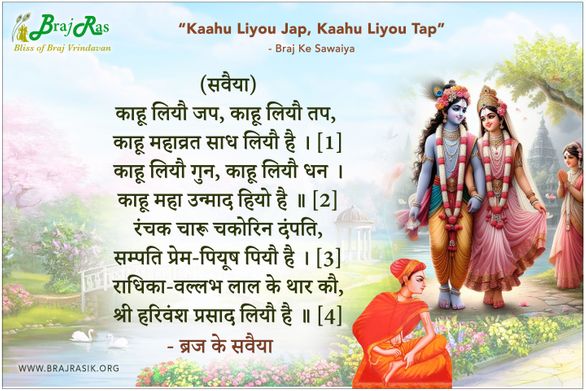
Kaahu Liyou Jap, Kaahu Liyou Tap,
Kaahu Maha Vrat Saadh Liyou Hai. [1]
Kaahu Liyou Gun, Kaahu Liyou Dhan,
Kaahu Maha Unmaad Hiyo Hai. [2]
Ranchak Chaaru Chakorin Dampati,
Sampati Prem-Piyush Piyou Hai. [3]
Radhika-Vallabh Lal Ke Thaar Kou,
Shri Harivansh Prasad Liyou Hai. [4]
- Braj Ke Sawaiya
This Sāvaiyā has been renowned since ancient times for emphasizing the exclusive devotion of Śrī Hita Harivansh Mahāprabhu to Mahāprasād. To uphold this devotion, he instituted the practice of not forsaking Mahāprasād even on Ekādaśī, which led to severe opposition from the contemporary Vaiṣṇava community. The disregard shown by Śrī Hita Harivansh Mahāprabhu for traditional practices became widely known. The meaning of this verse is as follows:
Some engage in japa, others pursue austerities, and many undertake strict vows. [1]
Some seek righteousness, others crave wealth, while still others delight in fulfilling their personal desires. [2]
Like a Chakora bird constantly gazing at the moon of the Divine Couple, Śrī Śyāma-Śyām, he drinks the nectar of divine love — his only treasure. [3]
His entire devotion lies in the Mahāprasād of Śrī Rādhikā-Vallabha — he is none other than Śrī Hita Harivansh. [4]
Kaahu Liyou Jap, Kaahu Liyou Tap,
Kaahu Maha Vrat Saadh Liyou Hai. [1]
Kaahu Liyou Gun, Kaahu Liyou Dhan,
Kaahu Maha Unmaad Hiyo Hai. [2]
Ranchak Chaaru Chakorin Dampati,
Sampati Prem-Piyush Piyou Hai. [3]
Radhika-Vallabh Lal Ke Thaar Kou,
Shri Harivansh Prasad Liyou Hai. [4]
- Braj Ke Sawaiya
This Sāvaiyā has been renowned since ancient times for emphasizing the exclusive devotion of Śrī Hita Harivansh Mahāprabhu to Mahāprasād. To uphold this devotion, he instituted the practice of not forsaking Mahāprasād even on Ekādaśī, which led to severe opposition from the contemporary Vaiṣṇava community. The disregard shown by Śrī Hita Harivansh Mahāprabhu for traditional practices became widely known. The meaning of this verse is as follows:
Some engage in japa, others pursue austerities, and many undertake strict vows. [1]
Some seek righteousness, others crave wealth, while still others delight in fulfilling their personal desires. [2]
Like a Chakora bird constantly gazing at the moon of the Divine Couple, Śrī Śyāma-Śyām, he drinks the nectar of divine love — his only treasure. [3]
His entire devotion lies in the Mahāprasād of Śrī Rādhikā-Vallabha — he is none other than Śrī Hita Harivansh. [4]