
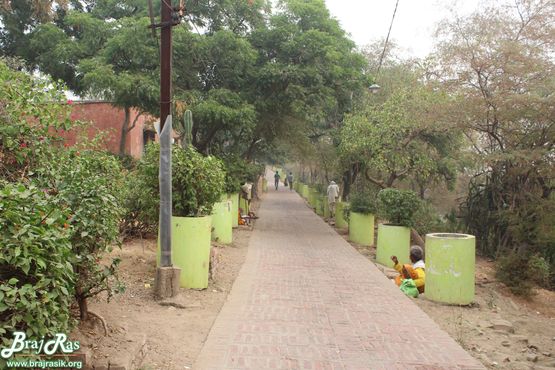
Barsana
Barsana is the place of sweet pastimes of Shri Radharani. The divine nectar is raining continuously here, hence it is called 'Barsana'. Barsana is the capital of King Vrishabhanu Ji, hence it is also called 'Vrishabhanupur'. Although Barsana is in Vrindavan itself, but because of Shri Radha's permanent residence, the entire Vrindavan becomes nectarous from here. Shri Krishn is pleased with the touch of the wind comes from the direction of Barsana, and considers the wind of that direction blessed, Mahaprabhu Shri Hita Harivansh is greeting the same direction of Barsana - "Tasya Namostu Vrishbhanubhuvo Dishepi" - Shri Radhasudhanidhi (1) Although the Panchayojana i.e. 20 kos (60 km) Vrindavan is all full of nectar, but Vyas Ji did not find Shri Krishn in that entire Vrindavan but got it in Barsana - Laagi Rat Radha Radha Naam. Dhundhi Phiri Vrindavan Sabro Nand Dithona Shyam. Kai Mohan Kai Khor Sankri Kai Mohan Nandgaon. 'Vyas Das' Ki Jeevan Radhe Dhani Barsano Gaon. - Shri Hariram Vyas Lord Shiva and Shesh Ji also desire to stay here. Barsane Ke Vaas Ko Aas Karen Shiva Shesh. Hyaan Ki Mahima Ko Kahe Jahaan Krishn Dhare Sakhi Vesh . The gem of the entire Braj Vrindavan resides only in Vrishbhanu Palace, Barsana, for whose temptation the 'Supreme Personality' comes here like a thief - Braj Mein Ratan Radhika Gori. Har Lini Vrishabhanu Bhavan Te Nandsuvan Ki Chori. - Shri Krishnadas Ji In Barsana, Shri Krishn disguised as a milkmaid comes to steal here. Subhag Gori Ke Gore Paay . Dhani Vrshabhaanu Dhany Barsaano Dhani Radha Ki Maay. Jahaan Pragati Natnaagari Khelat Pati Son Rati Pachhataay. Jaake Paras Saras Vrindavan Barasat Rasani Aghaay. Taake Sharan Rahat Kaako Dar Kahat Vyas Samujhaay. - Shri Hariram Vyas Ji Mahaprabhu Shri Hit Harivansh Ji has asked to come to Barsana - "Chalo Vrishabhanu Gop Ke Dwar" Or Dekhi Sakhi Radha Piy Keli Ye Dou Khor Khirak Giri Gahvar. Viharat Kunwari Kantha Bhuj Meli. Khor (Sankri), Giri (Brahmachal Hill), Khirak (Vrishabhanu Khera), Van (Gahvar Van) – these four are only in the Barsana. The pastimes of Gahvar Van and Khor Sankri were sung by 'Swami Shri Haridas Ji' - "Hamaaro Daan Maaryo In" Or Pyari Ju Aage Chali Aagein Chali Gehvar Ban Bhitar Jahan Bolai Koyil Ri. Ati Hi Bichitr Phul Patrani Ki Sejya Rachi Ruchir Sanvari Tahan Tub Soil Ri. Chhin Chhin Pal Pal Teriai Kahani Tuv Mag Joil Ri. Shri Haridas Ke Swami Syam Kahat Chhabilau Kam Ras Bholai Ri. The peacock dance pastimes of Mor Kuti have also been sung by 'Swami Shri Haridas Ji. Even Mahavani Ji says - "Gahvar Nikunj Kunj Ke Aage Adbhut Thaur" According to the Varaha and Padma Puranas, Brahma pleased Shri Hari at the end of Satya-yuga by performing arduous worship. Brahma then asked for the following boon: "Please perform Your sweet pastimes with the Vraj-Gopis on my very form and allow me to behold these pastimes. Please make my life blessed, by especially performing swing pastimes in the rainy season and by performing Holi in spring." Pleased with Brahma, Shri Hari instructed him, "Go to Vrishbhanupur and take the form of a hill there. In that form, you will be able to behold all Our sweet pastimes." And so it happened that Brahma assumed the form of a hill at this place in Braj and fulfilled his cherished desire. This is the reason why Lord Krishn ordered Brahma to become a mountain only in the Barsana to behold the sweet pastimes. Purakritayugasyante Brahmana Prarthito Harih. Mamopari sada tvamhi raaskridam karishyasi. Sarvabhibrajagopibhih Pravritkale Kritarthakrit. - Varah and Padma Purana At the end of the Satyuga, Brahma Ji prayed to Shri Krishn that "Oh Lord, please perform your sweet pastimes with the Gopis over me." The Lord said - "Go to Barsana and become a mountain, where you will behold the sweet pastimes." Due to this Brahma Ji became a mountain in Barsana. There is a context in Valmiki Ramayana that when Sita Ji was crossing Yamuna Ji during the time of exile, Sita Ji worshiped Yamuna Ji while crossing. She saw that this Yamuna was coming from Braj. There is a verse - Kalindi madhyamayata Sita tvenamavandata. Swasti devi tarami tvam paaryenme pativritam Yakshye twam gosahsrena suraghatashaten cha Swasti Pratyagate Rame Purimikshwakupalitam. - Valmiki Ramayan, Ayodhya Kand (55.19,20) Sita Ji said - "O mother! I will serve you with thousands of cows." Sita Ji was also a devotee of Braj. When Abhay Karna Ji came here, he was very happy and started serving the cows. That is why this is a separate lineage of Raghuvansh, in whose lineage there was Rashang Ji, who has established Barsana and Radha Rani appeared in his lineage. This is the history of Barsana. King Vrishabhanu and Shri Radha appeared in this lineage of Rashang Ji. These were Suryavanshi (Sun dynasty) and Shri Krishn was Chandravanshi (Moon dynasty). Here Shri Krishn is always fascinated by Shri Radhika - Param Nityam Radhapadkamalmule Brajpure. Tadityam Vithishu Bhramati Sa Mahalampata Manih. - Shri Radhasudhanidhi (232) Soi Tau Bachan Mosaun Mani Tain Merou Lal Mohyu Ri Saanvarau. Nav Nikunj Sukh Punj Mahal Mein Subas Basau Yah Gaanvarau. Nav-Nav Laad Ladai Ladili Nahin Nahin Ih Braj Jaanvarau. Shriharidas Ke Swami Syama Kunjbihari Pai Vaaraungi Maalati Bhaanvarau. - Shri Kelimal (44) Barsana village is below the Brahmachal mountain. Brahmachal mountain is a part of Brahma Ji. There are four bastions on the four summits of his face (1) Maangarh (2) Daangarh (3) Vilasgarh (4) Bhanugarh. Vrishabhanu Bhawan is situated on Bhanugarh, Danlila (Daan pastimes) has happened on Dangarh, Jhulan Leela (Swing pastimes) and Vilas Leela (dalliance) has happened on Vilasgarh and Maan Leela (pastime) has happened on Maangarh. There is also the Deity of Brahma Ji on Singhpaur, to which the devotees pay obeisance and have darshan of the four bastions on the mountain. Brahma Ji became a mountain here to get the dust of the Lotus Feet of Shri Radha. In the Bhagwat - Tad Bhuribhagyamih Janma Kimapyatavyam Yad Gokulepi Katamaangirajobhishekam. Yajjivitam Tu Nikhilam Bhagwan Mukund- Stvadyapi Yatpadarajah Shrutimrigyameva. - Shrimad Bhagavatam (10.14.34) Lord Brahma wanted the dust of the feet of any resident of Braj. The dust of the feet which the Shrutis are looking for till today, Brahma Ji got the same dust by the grace of Shri Krishn. Pastime Places in Barsana The parikrama of Barsana is four miles long. "According to the Padma Purana, two hills face each other here - one is Vishnu-Hill and the other is Brahma-Hill. Vishnu-Hill is on the left and Brahma-Hill is on the right. On top of Brahma-Hill is a temple of Shri Radha-Krishn. Close by to the north, on the lower side of this hill, is the palace of King Vrishbhanu, where one can have darshan of Shri Vrishbhanu Maharaj, Shrimati Kirtida Maharani, Shridama and Shrimati Radhika. Nearby is a temple of Shrimati Lalita, in which one can have darshan of Radhika along with nine Sakhis. "Also on top of Brahma-Hill are Daan Mandir, the place of a swing (Hindola), Mayur-Kuti, a Raas-Mandal, and a temple of Shrimati Radha. Further on between the two hills is Sankari-Khor. Near Sankari-Khor is Vilas Mandir, and next to Vilas Mandir is Gahvarvan. Within Gahvarvan are Radha-Sarovara and a Raas-Mandal, and nearby is Dohani-Kund. Very close to this Kund is Mayur-Sarovar, which was constructed by Chitralekha." Bhanu-Sarovar is also nearby, and on its bank is Vrajeshvar, a deity of Maharudra (Lord Shiva). On its left side is Kirti-Sarovar. There are four Sarovars, or ponds, around Barsana : (1) Vrishbhanu-Kund in the east, (2) Kirtida-Kund in the north-east, (3) Vihar-Kund (later named Tilak-Kund) in the south-west, and (4) Dohani-Kund in the south, southwest of the village of Chiksauli. Sankari-khor lies north of Chiksauli, and on Vishnu-Hill, east of Sankari-khor, is Vilas-Garh. This is the location of a Raas-Mandal. Near Vilas Mandir is where Radhika, as a child, played with the sand, built palaces, and so on. West of Sankari-Khor, on top of the mountain, is Daan-Garh; and south-west of Sankari-Khor and west of the village of Chiksauli are Gahvarvan and Gahvar-Kund. Mayur-Kuti is to the right when entering Gahvarvan. On the top of the hill, south-west of Gahvarvan, are Maan-Garh and Maan Mandir; and below and nearby is the village of Maanpura. North of Maan-Garh is the temple of the Maharaja of Jaipur, and north of that temple is Shriji Temple. Just below Shriji Temple, still on the hill, one comes to the temple of Brahmaji and the palace of Shrimati Radhika's paternal grandfather, Mahibhanu. Below that lies the village of Barsana. West of Barsana is Mukta-Kund, or Ratna-Kund. Location : Barsana is situated 20 km west of Govardhan, 9 km east of Kamyavan, and 50 km northwest of Mathura.