
(Savaiya)
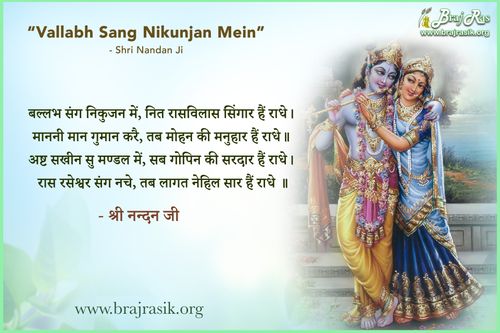
Ballabh Sang Nikujan Men, Nit Rasavilas Singar Hain Radhe. [1]
Manani Maan Guman Karai, Tab Mohan Ki Manuhar Hain Radhe. [2]
Asht Sakhin Su Mandal Men, Sab Gopin Ki Saradar Hain Radhe. [3]
Raas Raseshvar Sang Nache, Tab Lagat Nehil Saar Hain Radhe. [4]
- Shri Nandan Ji
Śrī Rādhā eternally performs Rāsa-vilāsa with Her beloved Śyāmasundara within the secluded nikuñjas, appearing Herself to be the divine and incomparable ornament of those bowers. [1]
When, as the Māninī, She assumes sulk in loving displeasure, it is Śrī Rādhā alone who becomes the object of Śrī Kṛṣṇa's humble and earnest entreaties to appease Her. [2]
Śrī Rādhā is the supreme Svāminī and crest-jewel among the circle of the eight principal sakhīs and of the entire assembly of gopīs. [3]
When She dances together with Śrī Kṛṣṇa, the Lord and sovereign of Rāsa-rasa, She appears to be the very essence and embodiment of divine love itself. [4]
Ballabh Sang Nikujan Men, Nit Rasavilas Singar Hain Radhe. [1]
Manani Maan Guman Karai, Tab Mohan Ki Manuhar Hain Radhe. [2]
Asht Sakhin Su Mandal Men, Sab Gopin Ki Saradar Hain Radhe. [3]
Raas Raseshvar Sang Nache, Tab Lagat Nehil Saar Hain Radhe. [4]
- Shri Nandan Ji
Śrī Rādhā eternally performs Rāsa-vilāsa with Her beloved Śyāmasundara within the secluded nikuñjas, appearing Herself to be the divine and incomparable ornament of those bowers. [1]
When, as the Māninī, She assumes sulk in loving displeasure, it is Śrī Rādhā alone who becomes the object of Śrī Kṛṣṇa's humble and earnest entreaties to appease Her. [2]
Śrī Rādhā is the supreme Svāminī and crest-jewel among the circle of the eight principal sakhīs and of the entire assembly of gopīs. [3]
When She dances together with Śrī Kṛṣṇa, the Lord and sovereign of Rāsa-rasa, She appears to be the very essence and embodiment of divine love itself. [4]