
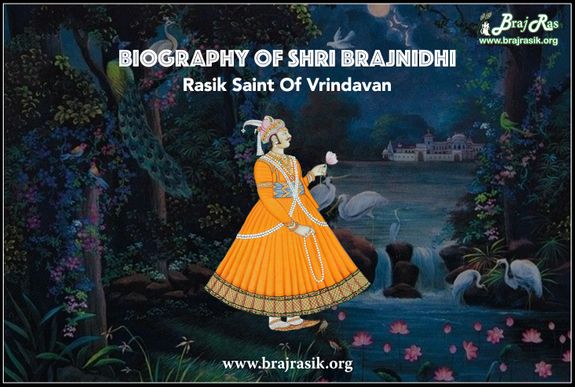
Genealogy and Birth :
Maharaj Pratapsingh Ji (Brajnidhi Ji) was like a sun of the famous branch of the Surya dynasty, the Kachwaha-dynasty. In the 196th generation from Lord Shri Ram, King Sodhadev Ji was born, who, along with his brave son Dulharai Ji, came to the country of Dhoodhad and became a successful king here. Maharaj Prithiraj was born in the 17th generation from Sodhdev Ji. In the family tradition of Prithiraj Ji, Maharaja Bharmal Ji, Mansingh Ji, Mirza Raja Jaisingh Ji, Sawai Jaisingh Ji, etc. were very brave, successful, virtuous, and revered Kings, whose names are still remembered due to their strength, education, policy, religious works and wealth, etc. Ishwarisingh Ji and his son Madhavsingh Ji were the successors of Sawai Jaisingh Ji, the settler of Jaipur city, the performer of Ashwamedh Yagya, the builders of astrology instruments, etc. Madhavsingh Ji's first son Prithisingh Ji was born in 1762 and the younger son Pratapsingh Ji (Brajnidhi Ji) was born on the 2nd day of the dark fortnight in the month of Paush (Dec-Jan) in 1762. Prithisinh Ji's mother's name was Chundawat Ji.
Childhood and Education :
Maharaja Sawai Pratap Singh's body was very handsome. He was neither too long nor too short; Neither too thick nor too thin. The color of his body was fair. The strength in his body was also sufficient. In his childhood, he had received education in scripture, martial arts, etc as it was a mandatory rule for princes in that era. It was the determination of his father, Maharaj Madhavsingh Ji, that these two brothers (Prithisingh Ji and Pratapsingh Ji) should become masters of Hindi and Sanskrit. Therefore, he had made adequate arrangements for their education.
Maharaj Madhavsingh Ji always respected the virtuous and wise man. Therefore, there was always a gathering of poets, sages, and devotees in his time. Because of this, Maharaj Pratapsingh Ji always used to learn new things. The nature of Maharaj was also very good. He was known for being cheerful, friendly, generous, and virtuous. He was also an expert in politics.
The accession of Pratap Singh Ji (Brajnidhi Ji) to the throne :
After the departure of Madhav Singh Ji, his eldest son Prithi Singh Ji sat on the throne at the age of 5 years. But in 1776, Prithi Singh Ji left this world. Then his younger brother Pratapsingh Ji sat on the throne on the 3rd day of the dark fortnight in the month of Vaishakh (April-May) 1778. He was approximately fifteen years old when he ascended the throne.
Marriage :
Maharaja Sawai Pratap Singh Ji was married to Bhatyani Ji with whom he had a son. The son's name was Jagatsingh.
Administration :
Maharaj Pratapsingh Ji started managing the administration as soon as he sat on the throne. To control wicked Firoz Mahavat, who was gaining power in the capital, Maharaj Pratapsingh Ji sent his army to the Rao of Manchadi, and he (Firoz) was poisoned and killed by Bohra Khushaliram. Mother Chundawat Ji also left her body. When Rao of Manchadi raised his head again, Maharaj Pratapsingh Ji lowered it by using his army. But Bohra Khushaliram was associated with Manchaidiwala, so he gave some area to that Rao. This also caused some loss to the state. On the other hand, the riots of the Marathas were increasing. Marathas used to do every tactic of recovering their Chauth (taxes) from Rajasthan. Maharaj Madhavsingh Ji, the father of Maharaj Pratapsingh Ji, had succeeded in bringing Malharrao along with the army to conquer Jaipur. At that time, some expenses of the army were also left to be paid. For this, Sendhia wanted to conquer Jaipur. Maharaja Pratapsingh Ji thought of a remedy that by joining other princely states, the Marathas should be expelled from Rajputana forever. That is why in 1786 he sent Daulat Ram Haldia to Maharaja Vijaysingh Ji of Jodhpur and said that if you are with me, we can kill the Marathas and drive them out. Vijay Singh Ji wanted this thing to happen for many years. He immediately sent the army. In 1786, the combined army of both the states defeated Sendia's army in the great battle of Lunga (a town near Dyausa) in such a way that the terror of Rajput valor fell upon all the Marathas. But after four years, Sendhia again attacked Jaipur and then Jaipur called for an army of Rathores in the aid. In 1791, there was a heavy battle at Patan (Torawati) in which Jaipur was first victorious, but the Champawats of the Jodhpur army did not help further and Jaipur was defeated by this betrayal. Seeing this opportunity, Holkar also marched again and Jaipur had to reconcile with the Marathas due to poor conditions at that time. However, sometimes there were fights with Sendias and sometimes Holkar, due to which the state suffered a lot.
Quoting the journey of George Thomas, Kaviraj Shyamaldan Ji had written of a heavy battle between the Marathas and the Rajputs, at Fatahpur (Shekhawati), in 1799, with Holkar and Baman Rao on the Maratha side with an army and cannons. The army of Jaipur gave them heavy defeat and after chasing them for a long distance caused great harm. The forces of Bikaner and Kishangarh also came for help in this battle. In relation to the victory of Tunga, Colonel Tod Sahib has written a lot of praise of Maharaj Pratapsingh Ji - "Maharaj Pratap Singh himself had operated the army on the battlefield. Because of this, this victory was considered special in his favor. After winning the war, Maharaj Pratapsingh Ji distributed 24 lakh rupees in a big festival. By winning this battle, the glory of the fame of King of Amer (Jaipur) Maharaja Pratapsingh Ji spread in all the princely states. Pratapsingh Ji was a great warrior and wise king." But hardly any king has faced as many problems as Maharaj Pratapsingh Ji did in redressing the objections that were present at that time due to the robberies of the Marathas and the plundering of the Pindaris.
It is written in the genealogy of Jaipur (Khyat) that after the victory of Sendiya Patel, the emperor of Delhi came to the camp of Rewari. There the King of Jaipur Maharaj Pratapsingh Ji went to meet him. At that time the emperor was very pleased with his intelligence and valor and offered him the post of minister. The Maharaj, talking of courtesy, avoided it.
Maharaj Pratapsingh Ji had to face great difficulties in his life in suppressing the Marathas etc. and in doing many wars etc. The cost of battles and the objections and sufferings one has to bear are not hidden from the wise men.
The treasury of Jaipur, which was considered to be the storehouse of Kuber, was largely emptied in these wars. It was full during the time of Maharaj Sawai Jai Singh Ji. A part of it was also spent during his time in the Ashwamedha Yagya, the construction of Jaipur and the ascent of Jodhpur, and other battles. Then a huge amount was lost in the fight between the brothers Ishwarisingh Ji and Madhavsingh Ji. Even in this condition, Maharaj Pratapsingh Ji spent expenses of all the battles with his wisdom and morality and with great valor, courage, and ability, protected the state during the difficult period when India was engulfed in deep turmoil and this state was attacked from time to time by enemies. In India, it was a time of epoch or change of era, whose recent history is well known to the readers.
Famous Works [Hava Mahal in Jaipur and other] :
During the time of Maharaj Pratapsingh Ji, many buildings were also built; For example, Chandramahal has many huge buildings, Ridhsidhpal, Badha Diwankhana, tank behind Shri GovindJi, Hawa Mahal, Shri Govardhannathji's temple, Shri Brajrajvihariji's temple, Thakur Shri Brajnidhiji's temple, Shri Pratapeshwarji Mahadev's temple, the tunnel from personal palaces to Hawa Mahal, Shri Madanmohanji's temple, etc. The repair of Jaipur's machinery was also done. Forts were repaired and new guns were made. The workmanship of 'Hawamahal' is famous in the world which He built. Maharaj Pratapsingh Ji loved Hawa Mahal very much. His devotion to God was also a factor in its construction, as Maharaj has written in "Shri Brajnidhi-Muktavali"-
Havamahal Yaaten Kiyo, Sab Samajho Yah Bhaav.
Radhe Krishn Sidhaarasi, Daras Paras Ko Haav.
Spiritual Initiation :
When Shri 'Shriji' Shri Sarveshwar Sharandevacharya Ji Maharaj was anointed at All India Jagadguru Shrinimbarkacharyapeeth, then after some time he reached Jaipur, where Maharaja Pratapsingh Ji gave him special respect by taking Vaishnav initiation from him and according to his orders, the great saints of other Vaishnava sects were also given due respect. In this regard, the eminent poet of Jaipur Shri Mandanbhattji has written in the context of Shri Sarveshwarsharandevacharyaji -
Madhav Maheendr Sut Shripratap,
Bulavaay Kiye Guru Kari Milaap.
Nij Mahal Beech Mandir Banaay,
Taamen Padharaaye Shir Navaay.
Radhanandnandan Bhaktibhaav,
Seekhe Prataap Nrip Rachi Subhaav.
Kar Diye Raghukul Ke Guru Ganesh,
Saanche Sevak Huv Prataapesh.
Tin Guru Charanan Ko Yog Paay,
Diye Sampradaay Chaaron Jamaay.
Maharaj Brajnidhi Ji became a devotee of the Lord due to the association of Jagannath Bhatt Ji who is also known as Kishori Ali (a disciple of Vanshi Ali), in whose praise Maharaj Brajnidhi Ji has written -
Main Kahaun Kaha Ab Kripa Tumhaari.
Yaahi Kripa Kari Gur Mai Paye Jagannath Upakaari.
Jaatein Meri Lagan Lagi Hai Taakau Det Mila Ri.
"Brajnidhi" Raaj Sanvaro Dhota Taakau Diye Bata Ri.
- Haripad - Sangrah 191
He used to adore Shri 'Vanshi Ali’ as well who sown the devotional nectar in the heart of Maharaj Pratapsingh Ji.
Love towards the Deity and His direct vision :
Just as Shri Brajnidhi Ji was proficient in conquering the external enemies, similarly he was able to conquer the internal enemies (greed, anger, etc.). His heart was always eager to worship the Lord and associate with devotees and virtuous men. Shri Brajnidhi Ji was an exalted devotee of the Lotus Feet of Shri Radha-Govind Ji. Due to His grace, Brajnidhi Ji got the benefit of devotion and he composed many texts which describe his devotion. After the darshans of Shri Radha-Govind Ji, Brajnidhi Ji would recite the praises or verses, which he himself used to create regularly. On special occasions and festivals, many celebrations used to take place. Raas Leelas are performed. It is said that Shri Govind dev Ji used to give him direct darshan in His childhood and youthful form. This is also evident from his poems, in which this direct darshan is mentioned.
Rekhata
Guldavadi Bahaar Beech Yaar Khush Khada Tha.
Guljaar Gul Sanam Ki Gul Se Bhi Gul Pada Tha.
Poshaak Rang Havaasi Saj Ke Dhaj Ka Tadatada Tha.
Pukhraaj Ka Bhi Jevar Nakh-Sikh Ajab Jada Tha.
Vah Noor Ka Jahoor Ada Par Ladajhada Tha.
Dekhate Hi Maine Jisako Ain Adabada Tha.
Dil Ka Dalel Dilabar Dil Chorane Ada Tha.
Brajnidhi Hai Vohi Dadhi Par Chhal-Bal Se Chhuk Lada Tha.
- Rekhata-Sangrah 168
Establishment of Lord Shri Brajnidhi Ji :
After some years, His vision [of the Lord] was obstructed due to some transgressions that only Maharaja Sawai Pratap Singh Ji knew. At that time Pratap Singh Ji was very disturbed. Then he was commanded in the dream that "According to your love, make a separate idol of mine and make a temple near the palaces and establish me there, you will have darshan there." Therefore, Maharaj made the idol of Shri Brajnidhi Ji with his complete love. Some say that the face of the idol was personally carved by Maharaj Sawai Pratap Singh Ji with his own hand. Then there was a big celebration of the prestige of Patotsav in the temple and the marriage of Priya-Priyatam (Radha-Krishn) took place at 'Daulatram Ji' Haldia [Lord Krishn in the form of an idol named Shri Brajnidhi stayed with Maharaj Pratapsingh Ji and the idol of Shri Radha was staying with Daulatram Ji, who looked Her as his daughter]. That is, after going to Daulatram Ji's place, Lord Shri Brajnidhi Ji got married and Shri Radha came to the temple in the palace of Maharaj Pratapsingh Ji. Daulatram Ji did all the things which were necessary for the marriage of the daughter with great expenditure and enthusiasm. And then, on all the festivals, Daulatram Ji used to send the clothes, jewelry, foods, etc. to His daughter. Even today his descendants send these offerings to the temple.
Shri Govind dev Ji has been described by Brajnidhi Ji himself as his presiding deity.
(Raag Bihag)
Hamaare Isht Hai Gobind.
Radhika Sukh-Sadhika Sang Ramat Ban Svachchhand.
Hiye Nit- Prati Basau Vrajnidhi Bhaavati Nandlal.
- Hari-Pad-Sangraha 163
Lord Shri Brajnidhi Ji gave the name "Brajnidhi" to Pratap Singh Ji :
The name "Brajnidhi" was given to Maharaja Sawai Pratap Singh by Lord Himself. Maharaja has said the same thing in this way-
Rekhata
Dil Tadapta Hai Husn Tere Ko.
Kab Milega Mujhe Salona Syam.
Ab To Jaldi Se Aa Daras Deejai.
Jo Inaayat Kiya Hai Brajanidhi Naam.
- Hari-Pad-Sangrah 165
Sorath (Dev Gandhar Dheema Chheet)
Saanchi Preeti Son Bas Syam.
Dharyau Brajnidhi Naam Tau Ab Lijiye Chit Chori.
- Hari-Pad-Sangrah 166
Composition :
Maharaja Sawai Pratap Singh Ji was a good poet, who used to put the mark of Brajnidhi in his poems. Many people used to call him Brajnidhi also. Misrabandhus in their compositions mentioned some of the text of Brajnidhi Ji - 1. Shringar-Manjari, 2. Neeti-Manjari, 3. Vairagya Manjari etc. and the time of composition is considered to be 1778. The commentaries on Sneh Sangram, Sanchsagar, Rekhta, and Bhartrihari Shatak are considered to have been composed in 1795. The collection of his works has been published by the Nagari Pracharini Sabha, Kashi in the name of "Brajnidhi Granthavali".
Under the poetry of Maharaja Sawai Pratap Singh Ji, along with policy, detachment, preaching, Shringar, meetings, separation, love, and worship, the pastimes of Raas have been depicted in a very excellent form. Expressing the uniqueness, humility, and love towards Shri Radhamadhav, Brajnidhi Ji has also given a beautiful representation of the Raas dance, drama, and conjugal meetings under Raas pastimes. Under his compositions, the use of Braj language includes words from Rajasthan, Punjab, Sanskrit, Urdu, Persian, and local. By the use of words from these languages in the compositions, while on the one hand, the quality of Braj language is reflected, on the other hand, the melody of Braj language also remains constant.
In this way, Brajnidhi Ji used to give help and encouragement to the festivals related to the imitation of Raas pastimes but also used to compose the verses related to Raas pastimes with great devotion. Due to the exclusive devotion of Shri Radha Krishn, Brajnidhi Ji's text related to Raas pastimes is a traditional and joyful factor.
Ham To Chaakar Nandkishor Ke.
Rahen Sada Sanmukh Rakh Liye Gauri Garab Garur Ke.
- Brajnidhi Granthavali, Brajnidhi Muktavali, Pad-19
Even in his Raas Pastime-representation, the melodious sound of the flute comes first. Here too, the flute of Shri Krishn broadcast the melody of such sweet love, that the Gopis become impatient because of the yearning for the union of Shri Krishn and they walk away.
Mohan Madan Mantr Padhi Daaryo.
Ghar Mein Rahyo Jaat Nahi Sajani Vansi Mein Lai Naam Uchaaryo.
- Brajnidhi Granthavali, Brajnidhi Muktavali, Pad 71
This melodious sound of the flute of Shri Krishn had cast such a charm that all the Gopis were tired, astonished, and subdued. As a result, along with the melodious voice of the flute, the sounds of various instruments played by Gopis and the sounds of the ankle bells also created an unprecedented musical stage in the Raas Pastimes of Vrindavan.
Raajat Bansi Madhur Dhuni Man Mohan Ki Aan.
Sunat Thakit Chakrit Rahi Adbhut Ati Hi Taan.
- Brajnidhi Granthavali, Premprakas, 36
Shri Brajnidhi Ji has not only described Raas pastime in his composition named 'Raas Ka Rekhta', but in many other compositions, he also made Raas pastime a subject matter. The sweet recitation of Tathai-Thai by Lalita in the middle of the circle-shaped Raas, the nectarous observation of the divine couple, eye signs, instrumental playing, sound of the flute, dance, and Lord Shiva's entry into Raas dance, etc. Shri Brajnidhi Ji has created unprecedented nectar in his texts.
Lalita Diyo Ughatati Taatheyi Theyi Theyi.
Raas - Mandal Beech Jhehen Piy Pyari.
- Brajnidhi Granthavali, Raas Ka Rekhata
In this divine Raas pastime, Shri Krishn displays his ever-new skills, as well as the atmosphere, Gopis, efforts, decorations, songs-singing, musical sounds, humor, love talks, gestures, etc., are also constantly visible in a very new form.
Phulavan Son Jhuki Rahi Lata Mahin Thaadhe Jahaan Kunvar Natnaagar.
Naval Laal Nav Baal Bhaal Gal Basan Naye Bhooshanahi Ujaagar.
- Brajnidhi Granthavali, Brajnidhi Muktavali, 61
The description of the Kunj-Raas dance of the divine couple along with Sakhis, which Shri Brajnidhi Ji has also described, is also an indication of the excellence of music and nectar.
Viharat Radhe Sang Vihari.
Kunj Bhavan Seetal Drum-Chhaiyaan Chand-Jyoti Ujiyaari.
- Brajnidhi Granthavali, Brajnidhi Muktavali, 31
In this Raas dance, the skill of singing, dancing, instrumental, and Shri Radha together is displayed in such an extraordinary way that Shri Krishn becomes unconscious.
Naval Vihari Naval Tiy Jori Param Praveen.
Gaan Dou Kari Paras Par, Bhaye Adhik Adheen.
- Brajnidhi Granthavali, Brajshringar, 36
In this way, Shri Radha makes Shri Krishn unconscious with Her skill and also restless.
Prem Mein Chhake Hain Dou Ras Ki Chuhal Badhai,
Gaan Kiyo Aani Piy Pyari Ati Aan Soan.
- Brajnidhi Granthavali, Braj Shringar, 40
The climax of Raas Pastime, the celebration of the conjugal meeting of the divine couple has also been depicted by Shri Brajnidhi Ji in a very melodious manner. In this representation, along with Raas-dance, only two forms of Raas Pastime are targeted in a very elaborate form.
Disappearance :
In this way, while protecting the kingdom and keeping firm devotion at the Lotus Feet of his supreme deity Shri Govindev Ji, Maharaj Sawai Pratap Singh Ji now reached the stage where His mind was disturbed due to innumerable worries and blood disorders in his body and then diarrhea became stronger. In this state, he would often rest in the basement under the Lotus Feet of Shri Brajnidhi Ji. At that time, there were very well-known physicians, who, through the use of medicine, had even frozen the water-filled cistern. But even those medicines were unable to stop this diarrhea. Finally, Maharaj Sawai Pratap Singh Ji left his mortal body on the 13th day of the bright fortnight in the month of Sawan (July-Aug) in 1803. A well-known, mighty, wise, scholar, virtuous, and poet king had left this world! But he left his fame, which is remembered for his supernatural works, literature, virtuous deeds, and love for God. Maharaja Sawai Pratap Singh Ji's cremation took place in 'Gator', where are the tombs of his ancestors (father and grandfather). At the same time, the beautiful umbrella of white stone remains to protect his memory. After him, his son Maharaj Jagatsingh Ji sat on the throne.