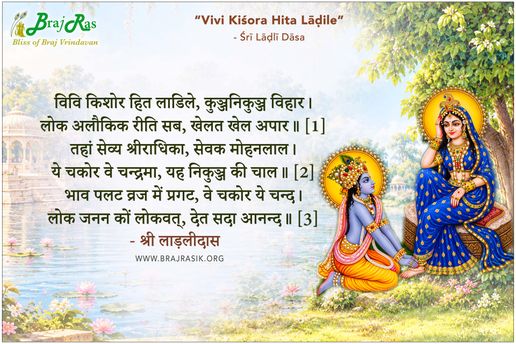
Vivi Kishor Hit Ladile, Kunjanikunj Vihar.
Lok Alaukik Riti Sab, Khelat Khel Apar. [1]
Tahan Sevya Shriradhika, Sevak Mohanalal.
Ye Chakor Ve Chandrama, Yah Nikunj Ki Chaal. [2]
Bhaav Palat Vraj Men Pragat, Ve Chakor Ye Chand.
Lok Janan Kon Lokavat, Det Sada Anand. [3]
- Shri Ladalidas
Describing the distinctive nature of Nikuñja Bhāva in contrast to Braja Bhāva, Śrī Lāḍilī Dāsa Jī explains that in Nikuñja Bhāva, Śrī Rādhā is the principal object of worship (i.e., the One who is served), however, this sentiment is reversed in Braja Bhāva, where Śrī Kṛṣṇa becomes the principal object of divine love.
The two youthful Divine Beloveds, Śrī Rādhā-Mohana, who are exceedingly dear to Śrī Hita, revel in various groves and secluded bowers, engaging in endless loving pastimes in both conventional and transcendental ways. [1]
Within Śrī Nikuñja, Śrī Rādhikā is the One who is served, while Mohanalāla Śrī Kṛṣṇa is Her loving servant. There, Śrī Kṛṣṇa is like the Cakora bird, and Śrī Rādhā is like the moon. Just as the Cakora gazes upon the moon continuously, Śrī Kṛṣṇa remains immersed in the love of Śrī Rādhā. Such is the distinctive nature of Nikuñja. [2]
However, this very sentiment appears in a reversed form in Braja pastimes. There, Śrī Rādhā is like the Cakora bird, while Śrī Kṛṣṇa is like the moon. Thus, the Divine Couple, through Their pastimes resembling the ways of the world, continually bestow bliss upon worldly beings. [3]